Everyone on this planet is engaging in change in some way. For those who didn’t notice, or misread, like a bit of heat, or want some fertiliser on their revolutionary garden: here are some reasons why more and more of us are working on a new status quo of creative development.
You see, the issue is the default methods and techniques of design orthodoxy are unfit for the world we’re in. When we say design orthodoxy, we mean the fixed, prescribed, narrow, ‘right,’ design processes we’re told we must use. They’re what recently (in the last 40 years) became the factory settings of craft, the default mode, and ‘common knowledge.’ And yet, the approaches are already in their cultural autumn. In part because they became popular through manipulation and tapping into status quo views, not because they genuinely enhance the creative process. The signs are there for a pivot.
We need a new story of creative development because:
Professional Pushback Against Design Orthodoxy
Design orthodoxy proclaims itself to be the bee’s knees. While there are still newcomers, some educators, researchers, and executives who believe the big claims of story gurus, most steer clear. In his article, “Friends Don’t Let Friends Write to Formula,” ex-screenwriter and industry educator Corey Mandell relates how he was hired by director Ridley Scott to work on a screenplay. Scott warned him: “If you try to write this script to one of those bullshit film school formulas you’ve been taught, I’ll fire your ass and hire a real writer.” In Beyond the Hero’s Journey, BAFTA- and AWGIE-winning screenwriter Anthony Mullins explains that, “I don’t know any professional screenwriter who routinely applied it [Hero’s Journey] in their screenwriting practice. I knew a lot of beginning screenwriters who tried to use it with varying success, but when it came to writers who make a living from their craft, they had moved away from the Hero’s Journey and found their own way of tackling a story.” It is a helpful signal to see how much push back there from those who’ve “made it.” But we also need to listen to the criticisms of those who don’t survive or don’t want to be in conventional film, TV, and games. They called the alarm, too, and sooner.
Pivot: Craft now defaults to methods and techniques for finding your way of tackling story. (For example: Pilar Alessandra‘s Guidance on When and How To Break the Rules; Dannenbaum et al’s Insights into balancing personal connections and challenges; LaPensee ́ et al’s Enacting Sovereignity Method)
A.I. Has Made Formulaic Writing The New Floor
Because of the assumptions story gurus popularised (more on this in another article soon), some creatives think that the design process is purely about finding and using what is already out there. Generative AI is built on the stolen use of a massive amount of stories, and guided by trainers. The majority of these trainers, both writers and not, draw on design orthodoxy and status quo thinking. The writing that AI produces, therefore, is highly formulaic. Ironically, this raises the bar. Design orthodoxy is now the bare minimum and can be produced in seconds. In a recent social media post, writer, journalist, and editor Samantha Dunn explained that “AI has already completely changed the game. It has permanently upped the stakes on what we writers must offer our audiences. In seconds, Gemini, Claude, ChatGPT or whatever can deliver standard service journalism […] Yes, there are sometimes issues of accuracy, but the larger point here is that it’s PASSABLE” (original emphasis). So, “[w]hat feature writers MUST deliver is their human discernment — their observations, their judgment, their conclusions drawn from experience and research. Writers have to be HUMANS talking to other HUMANS. Writers must deliver insight. Good writing = good thinking.” Likewise, on an episode of their co-run podcast Scriptnotes, screenwriter Craig Mazin explains that AI will only affect some writers: “If you are mediocre, maybe you are going to be out of a job, but you are probably going to be out of a job anyway because that’s how mediocrity works.” I read this situation as a opportunity. Now more gatekeepers want uniqueness. Now our subjective insights are becoming the new norm.
Pivot: Craft now defaults to methods and techniques to heighten our skills and draw on our uniqueness (For example: Corey Mandell’s Creative Integration Process, Linda Aronson’s Vertical & Horizontal Thinking Balancing Method, Sarah Fawn Montgomery’s Disabled Form Method, and Sonya Huber’s Naming Your Many Voices Method)
There Have Always Been A Wide Range of Methods
While design orthodoxy uses tactics to hide or dissuade you from seriously engaging with the variety of design methods available, the fact is they’ve always existed. There have always been the exceptions to the rules (sorry, McKee, “principles”™️). Indigenous storytelling pre-dates Aristotle and engages with a “timelessness” that isn’t about freezing everything in a moment and copy-pasting it into infinity. There are Eastern methods, at least six kinds of the Heroine’s Journey, passive protagonists, unchanging protagonists, queer forms, non-linear, different shapes, and more available and emerging. We live in a pluriverse not a monoverse. This means the skill missing from design orthodoxy is that of choosing structures, methods, techniques, mixing…and generating your own.
Pivot: New status quo where everyone learns the skills to choose which approach may suit their project context. (For example: Anthony Mullins’ Method to Choose an Arc According to Character Choices; Jane Allison’s Visual Method of Choosing a Structure; Linda Aronson’s Ensemble Size and Social-Cultural Method to Choose the Right Parallel Narrative, and Stayci Taylor’s Method of Generating a Queer Journey)
Demand for Impact Storytelling
There has been a growing call for creative works, including entertainment, to deliberately engage with climate and social change storytelling. The Hollywood Climate Summit, Climate Story Labs, Playing for the Planet, Represent Justice, are examples, and there are of course more. But by default, design orthodoxy excludes impact storytelling methods and techniques. This is because the underlying premise of design orthodoxy is that design doesn’t carry meanings and is separate from society. By default, design orthodoxy also excludes designing to context. The premise being that methods and techniques do not change, people don’t change, and every project and every person is the same or should be. This absolves creatives of any responsibility and impact is relegated to non-fiction productions and other educational content. There is utility in one corner and entertainment in another. The shift is to return to an understanding of how we’re all connected and we all co-design the world, whilst also drawing on the insights of what the invention of fiction enabled.
Pivot: Development defaults to deliberate meaning design, and all projects measure social and environmental impact. (For example: Learning for Action’s Media Measurement Framework; OKRE’s Unified Games Impact Framework; and Responsible Media’s Measuring Media’s Footprint and Brainprint — I’ll share my craft-oriented transformation scope shortly, too!)
Activists Use Story Design in Narrative Change Campaigns
There has been a growing use of dramatic storytelling techniques in activist campaigns. Specifically, in narrative change campaigns, where the goal is shifting a damaging deep cultural story in society (such as “people are poor because of their personal choices”). Understandably, but unfortunately, campaigners often use story design orthodoxy. By default, design orthodoxy excludes meaning design. The premise of design orthodoxy is that stories don’t say anything, dramatic techniques are discovered not made, and everyone is naturally change-antagonistic and values antagonism. Audre Lorde gave us a great way of saying this: ‘the master’s tools will never dismantle the master’s house.’ This means creatives keep upholding the same deep cultural narratives and the same designs (they can only change the degree of spectacle, art style, and who is in the cast, crew, or audience), and activist campaigns send out mixed, or undermining, messages. We need to make meaningful design what travels the furthest, not contextless-design.
Pivot: Development defaults to deliberate meaning design, the skills to choose which approach may suit your project context, and all projects measure social and environmental impact. (For example: Good Energy’s Climate Reality Check; Roxane Blouin-Payer et al’s Gameplay Verbs and Antonyms Framework, and Sabine van Mering’s Promise Motivation Method)
Design Orthodoxy Isn’t About Quality
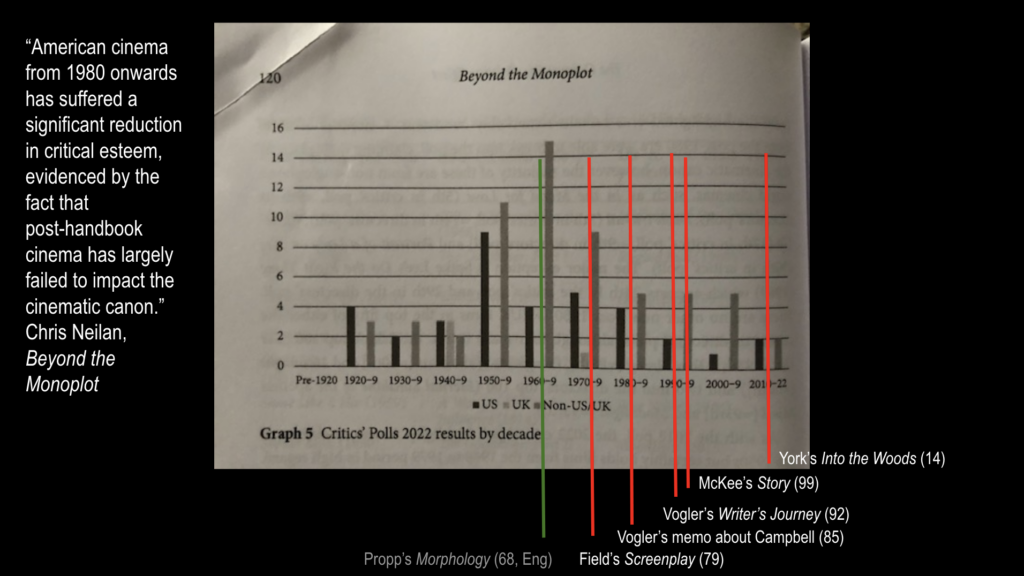
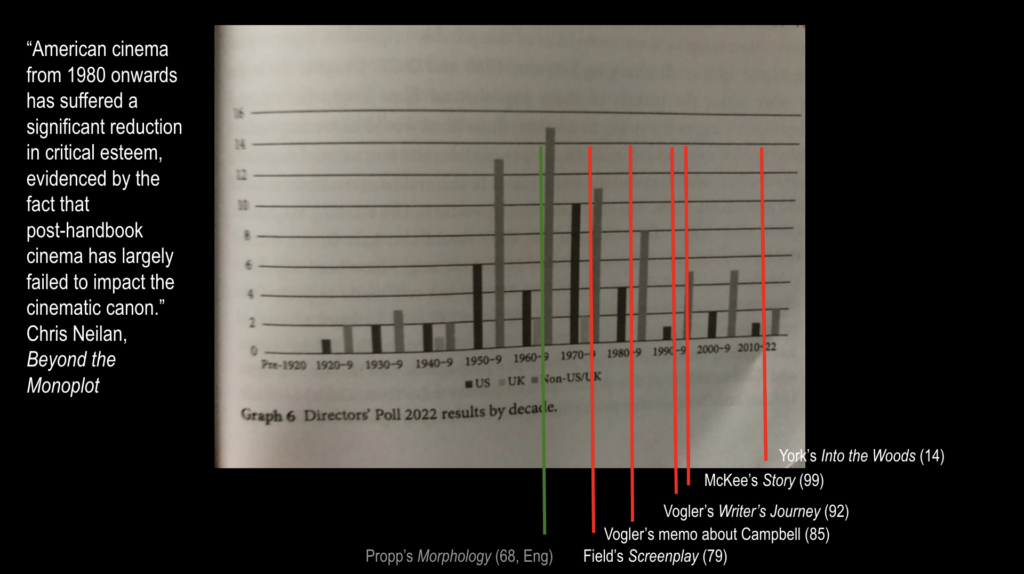
Design orthodoxy makes big claims about the proper way to create, and dissuades you from using other methods by framing them as the opposite of good, worthy, and valuable. In his book Beyond the Monoplot, screenwriter, teacher, and researcher Chris Neilan presents his quantitative analysis of critical consensus and peer esteem of feature films from pre-1920 to 2022. He showed that there has not been a significant increase in quality since the introduction of the methods and techniques of story guru manuals. In fact, critical regard is much lower compared to screenwriting pre-orthodoxy. Also, Neilan showed that before design orthodoxy was popularised, feature films enjoyed both critical and box office success. Afterwards, you’re more likely to have one or the other. The story gurus created a self-fulfilling prophecy. Investment, funding, and script assessors often draw on design orthodoxy even though it doesn’t indicate quality, because they don’t yet know how else to examine the works. We need to explore and spread methods for assessing without stencils, and put back in what is important.
Pivot: Development rejects false binaries such as art versus commerce, impact or entertainment, and instead focuses on responsible resonance and transformation, and other areas of concern. (For example: Centre for Public Impact et al’s Good Storytelling for Systems Change; Felicia Rose Chavez’s Anti-Racist Writing Improvements Objectives; Harmony Labs’ Values-Distinct Audiences)
Design Orthodoxy Doesn’t Increase the Likelihood of Success
Design orthodoxy makes big, false claims. The fact is, formulaic methods and techniques do not make everyone’s project better. As screenwriter and screenwriting teacher Neil Landau says in his book, The Screenwriter’s Roadmap: “If there was an absolute formula, every screenplay would be brilliant—and we all know that’s not the case.” As novelist Samuel R. Delaney says of different approaches in Pocket Workshop: “Masterpieces have been written with both methods. Both methods have produced drivel.” An analysis of Australian film success found that novice filmmakers earned a higher international ROI (return on investment) compared with experienced filmmakers. The reason being experienced filmmakers tended to become confidently myopic and not recognise or adapt to new opportunities (Rossiter & Mastoris). Despite it’s claims, design orthodoxy hasn’t lifted all boats. We need to decenter one-size-fits-all approaches and nurture what actually aids mutual flourishing.
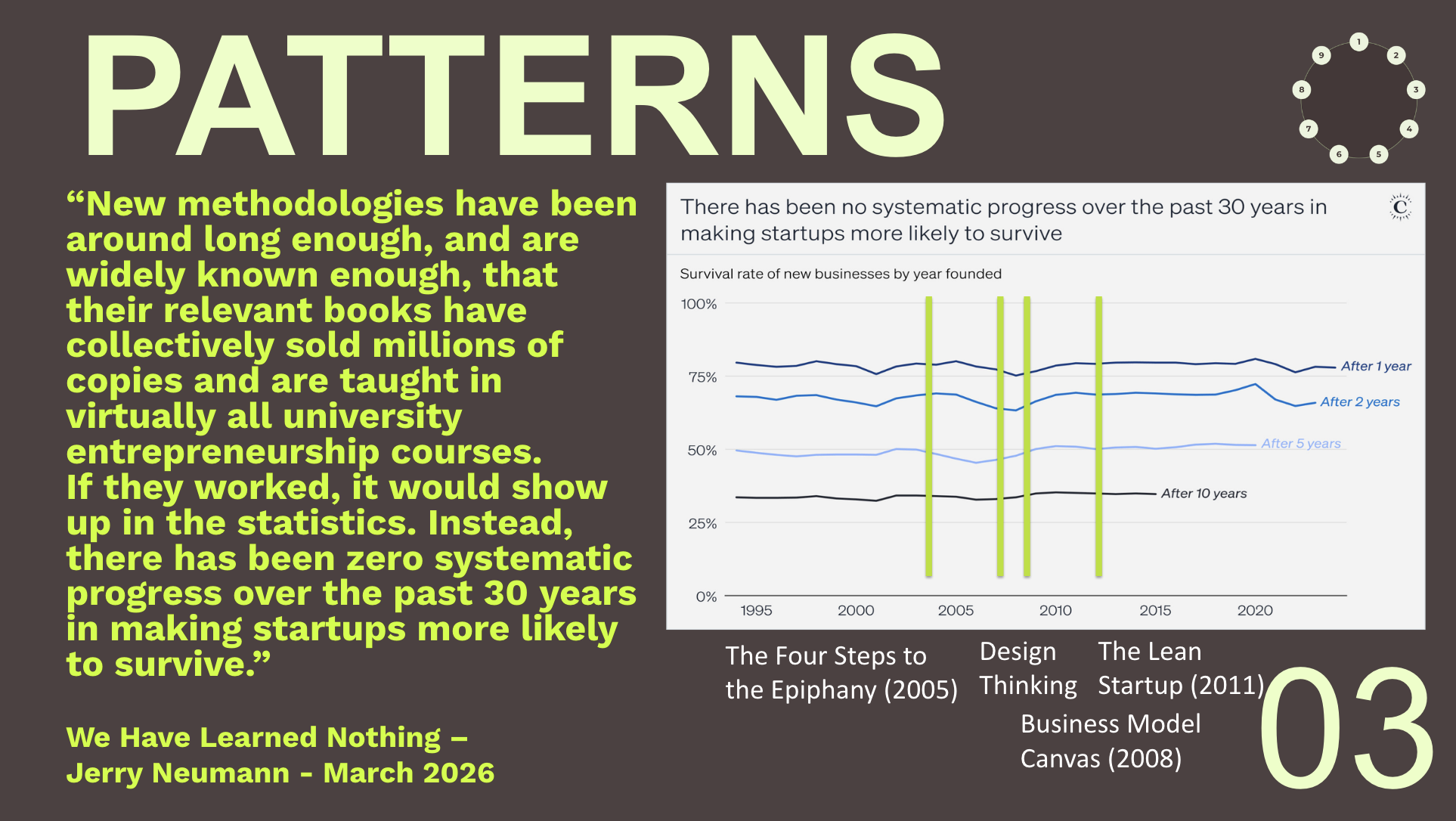
The lack of orthodoxy impact isn’t specific to creative productions. I attended Jane Korneyko’s talk at StartSpace a couple of months ago, and she detailed the research into how bestselling entrepreneur books (such as The Four Steps to Epiphany, Design Thinking, The Lean Startup, and the Business Model Canvas) have made zero impact on failure rates of startups. [Image below provided by Jane.]
A quote on her slide from Jerry Neumann (2026) says: “New methodologies have been around long enough, and are widely known enough, that their relevant books have collectively sold millions of copies and are taught in virtually all university entrepreneurship courses. If they worked, it would show up in the statistics. Instead, there has been zero systematic progress over the past 30 years in making startups more likely to survive.”
These are just some of the reasons why many of us are building a new story of creative development. There are more reasons why many of us are taking action, and more will keep emerging (tell me your reasons!). In the meantime, we’re building a new normal that is contextual, deliberate, impact-conscious, and about mutual flourishing…as a starting point.
How to cite this page:
Dena, Christy (2026) “Why We’re Changing the Story of Creative Development – Part 1,” Next World Narrative, 6 August Last updated 11 August, 2026. www.nextworldnarrative.org/articles/why-were-changing-the-story-of-creative-development/