Craft Language is an Offer You can Refuse and Change
I went to an improv session on the weekend. Jamie gave us an exercise where we offer our partner something to do together (for instance, “let’s go to a rock band concert”). If our partner said yes, we’d improvise being at a concert together. If our partner said no, we’d try another offer. Our task was to notice our partner’s response. How did they say yes or no? Did their eyes light up? Did they close down? I noticed that whenever they said ‘no,’ I loved it. Not that I preferred a no to a yes. A yes gives information about what they like and love. A no lets me know what doesn’t bring them alive. A no helps me get to know them.
I’ll share something about my brain with you. I automatically think about future trajectories based on present and past information. A new bit of information and the trajectories shift. I learnt to hide this way of thinking. If I mentioned how action X could lead to outcome Y, people would screw their face up. It seems some folks have no conception of how a mind could do that. They assumed I must be acting according to their world logic: I must be making big, false, claims about something I couldn’t possibly know. I must be paranoid. I must think I could do magic. I knew the steps along the trajectory, so their views didn’t change my mind about the insight. They did, however, for a time, contribute to me not sharing my thoughts. I may have done this to avoid disdain. I know I did this because I had no idea how to explain that my world is different to theirs. It’s not magic or some superpower. It’s as regular as my cup of tea, and lots of people drink tea.
Time isn’t one-way, either. I looked back to the past for explanations of the present. I remember when I was a teenager. One day, mid-afternoon, I suddenly felt despondent and self-loathing (more so than usual lol). I knew I didn’t feel that way when I woke up, so I traced my steps through the day. I realised that the negative thoughts and feelings emerged after reading Dolly Magazine (it was different then). I stopped reading those teen magazines. I had a little less prodding me feel unnecessarily down about myself.
When I was teaching interactive storytelling, game design, screenwriting, whatever subject it was, I noticed how students responded. I learnt what happens when I teach this way and that way. If I change the game design props from a chess board to plants, the nature of the games they make are considerably different. Then, later in the course, the kinds of games they pitched changed, and so on. I made new offers, learnt new paths, and gradually built new trajectories. I thought about the offers they got from teachers in other courses, and from fellow workers after university. Peers who will be hellbent on saying bullshit like money is the only reality, professionals must ghost people, and so on. I thought, what I can offer now that might stay with them in the future. I don’t define their future. But knowing what is highly likely to be coming, I can give them a different present. A present that lets them know they don’t have to go with what they’re offered. A present that encourages them to know what brings them alive and closes them down.
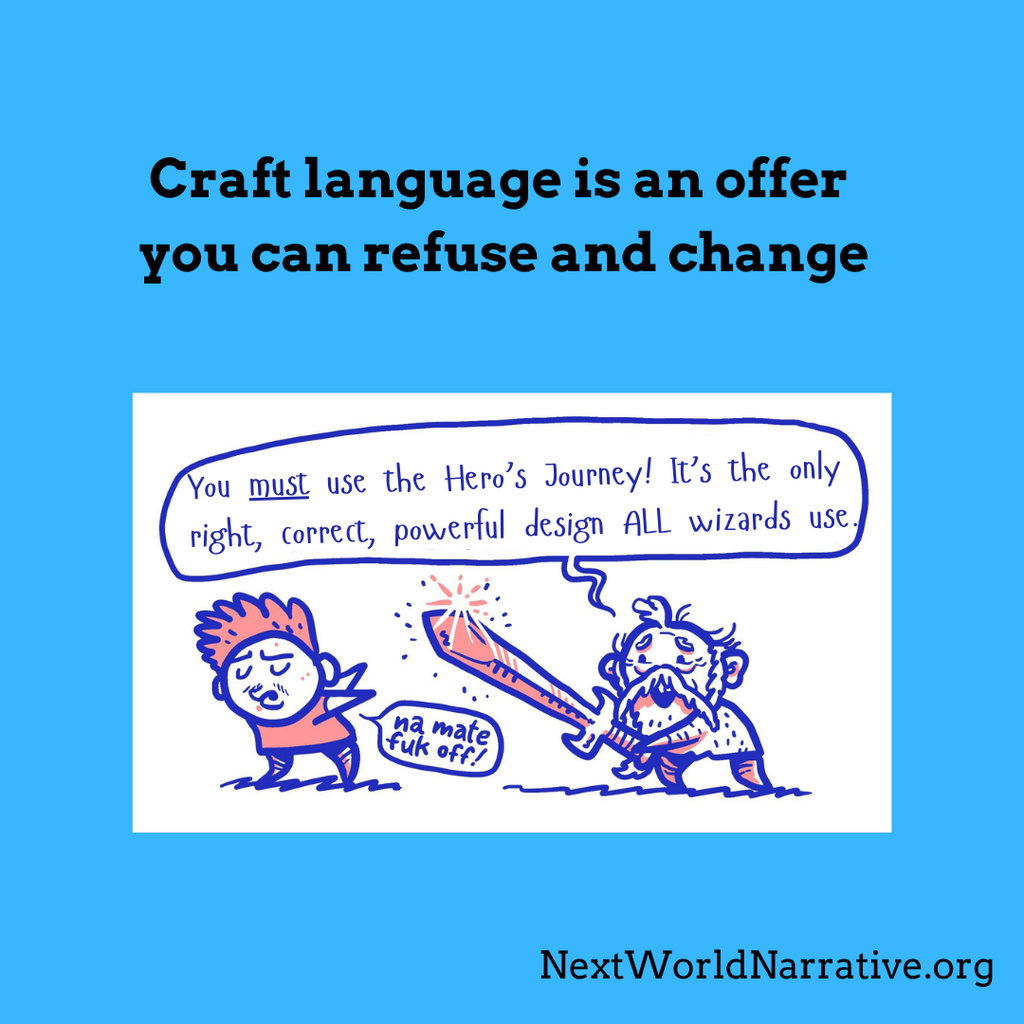
We don’t have to say yes to craft methods that don’t bring us alive. We can say no to their premise that design is fixed and we have no say in it. We can say no to their claims about the urgency of it all, and how their designs are the only way to be professional. In Strike!, documentary maker, historian and activist Jeremy Brecher details the history of (American) worker strikes. ‘If they refuse to work,’ he explains, ‘withdraw their cooperation, or take control of their own activity, “they have the power to reshape society.”’ Refusal says we don’t want this anymore and it gives space for what we do want. In Mohawk Interruptus, political anthropologist Audra Simpson details how the “people of Kahnawake” ‘had refused the authority of the state at almost every turn.’ Simpson calls it a ‘generative refusal.’ We can generate the world we want.
Recently, I ran public workshops on how we talk about craft. They were about the words we use when talking about screenwriting, game design, literature, development, peers, audiences, and so on. For instance, how continually using words like “commandment,” “physics,” and “natural law” to describe design can diminish a creative’s sense of agency. Calling different creative approaches a “sin,” “deviant,” or “unprofessional” not just delegitimises legitimate ways of creating, but also diverts many creatives away from their only way of flourishing. Sticks and stones can break my bones, but words can make me think I deserve it.
I ran the sessions because I noticed how alive I felt when I realised the words most story gurus use were closing me off what to really helps me, and that I could say no to them. At first, I noticed a pattern across many storytelling and game design manuals. I thought that the repetition of the same methods was a sign (as the authors claim) that they’re covering the good, great, true way to design. But the methods didn’t revolutionise my practice. No, it was when I noticed another pattern across the manuals that my practice evolved. They all use the same persuasive tactics to make me think they have the truth. Once I realised their tactics, the methods weren’t obligatory anymore. I didn’t have to go with their offers on how the world, creativity, and design works. I was free to find what suits me, and I did! I wanted others to know that, too. I put together preparation reading, and got to work.
It was a risk running the workshops because I wasn’t sure: 1) how many folks would be interested in the topic (or the way I framed it); 2) if folks would sign up even though it was direct to me and not through some big conference, festival, or institution; 3) if my costs would be covered as I deliberately made the workshops a choice of pay a relatively low fee, pay-what-you-want, or free. I ended up with colleagues from across three states in Australia, three states in the USA, UK, France, and Wales. I also had colleagues who couldn’t or wouldn’t make it, but wanted to chat via Zoom or email. Those interested included authors of screenwriting books, filmmakers, doco-makers, game designers, screenwriting university educators, researchers, and more. I knew them all, from my work across the last couple of decades and new colleagues. (So, I need to figure out how to communicate the insights to strangers, too.) My expenses were covered (but not my time). I loved learning what brought my colleagues alive and what they’re not interested in.
I shared the trajectories I see, backed up by my lived experience and research. I realised that there are very good reasons why some of the language used is appealing. I’m not talking about their persuasive strength. I’m talking about how their promises allude to positive things about the world. Promises they don’t deliver on. We can say yes to the promise and act on that, and no to the false practice they offer.
Outside of the workshops, I also noticed that a common response to the problem of Story Gurus giving bad advice is to police who gets to be a Story Guru. Undermining their power is helpful. What I think is also (even more) helpful is to know how it’s bad advice, and to promote a diversity of creative voices, not just a change of guard.
In the final workshop, I shared a tool to understand the relationship between the way we talk about craft, our everyday lives, and what is happening in the world. I have since then also figured out a way to systematise the ways to respond…using playfulness! Which is something one of the participants highlighted. Design orthodoxy language diminishes playfulness. But we know that creativity thrives in playfulness.
I noticed that the people who stayed to the end of all the workshops had shared qualities:
- Pain from being creatively and personally impacted by oppressive craft language
- Pain from actually, or concerned about, negatively impacting peers
- Yearning to have allies in their work and feeling emboldened to do something
- Yearning for a system to use in their own practice, teaching, & research
Based on that interest, I’m working on a short book version. I want it to bring the conversation about design back to how we can all flourish…how we can all feel alive when we create. I have a publisher who is interested and able to do this with a short turnaround. With that, I’d like to know what comes up for you. What are your ‘nos,’ ‘yeses,’ and ‘yes ands’ to anything I’ve said (and not said). This information helps me bridge my world with yours. Feel free to message me! Until then, yarrrrr, craft is an offer we can play with!
How to cite this page:
Dena, Christy (2026) “Craft is an Offer You Can Refuse and Change” Next World Narrative, 3 September. Last updated 4 September, 2026. www.nextworldnarrative.org/articles/craft-is-an-offer
Why We’re Changing the Story of Creative Development – Part 1
Everyone on this planet is engaging in change in some way. For those who didn’t notice, or misread, like a bit of heat, or want some fertiliser on their revolutionary garden: here are some reasons why more and more of us are working on a new status quo of creative development.
You see, the issue is the default methods and techniques of design orthodoxy are unfit for the world we’re in. When we say design orthodoxy, we mean the fixed, prescribed, narrow, ‘right,’ design processes we’re told we must use. They’re what recently (in the last 40 years) became the factory settings of craft, the default mode, and ‘common knowledge.’ And yet, the approaches are already in their cultural autumn. In part because they became popular through manipulation and tapping into status quo views, not because they genuinely enhance the creative process. The signs are there for a pivot.
We need a new story of creative development because:
Professional Pushback Against Design Orthodoxy
Design orthodoxy proclaims itself to be the bee’s knees. While there are still newcomers, some educators, researchers, and executives who believe the big claims of story gurus, most steer clear. In his article, “Friends Don’t Let Friends Write to Formula,” ex-screenwriter and industry educator Corey Mandell relates how he was hired by director Ridley Scott to work on a screenplay. Scott warned him: “If you try to write this script to one of those bullshit film school formulas you’ve been taught, I’ll fire your ass and hire a real writer.” In Beyond the Hero’s Journey, BAFTA- and AWGIE-winning screenwriter Anthony Mullins explains that, “I don’t know any professional screenwriter who routinely applied it [Hero’s Journey] in their screenwriting practice. I knew a lot of beginning screenwriters who tried to use it with varying success, but when it came to writers who make a living from their craft, they had moved away from the Hero’s Journey and found their own way of tackling a story.” It is a helpful signal to see how much push back there from those who’ve “made it.” But we also need to listen to the criticisms of those who don’t survive or don’t want to be in conventional film, TV, and games. They called the alarm, too, and sooner.
Pivot: Craft now defaults to methods and techniques for finding your way of tackling story. (For example: Pilar Alessandra‘s Guidance on When and How To Break the Rules; Dannenbaum et al’s Insights into balancing personal connections and challenges; LaPensee ́ et al’s Enacting Sovereignity Method)
A.I. Has Made Formulaic Writing The New Floor
Because of the assumptions story gurus popularised (more on this in another article soon), some creatives think that the design process is purely about finding and using what is already out there. Generative AI is built on the stolen use of a massive amount of stories, and guided by trainers. The majority of these trainers, both writers and not, draw on design orthodoxy and status quo thinking. The writing that AI produces, therefore, is highly formulaic. Ironically, this raises the bar. Design orthodoxy is now the bare minimum and can be produced in seconds. In a recent social media post, writer, journalist, and editor Samantha Dunn explained that “AI has already completely changed the game. It has permanently upped the stakes on what we writers must offer our audiences. In seconds, Gemini, Claude, ChatGPT or whatever can deliver standard service journalism […] Yes, there are sometimes issues of accuracy, but the larger point here is that it’s PASSABLE” (original emphasis). So, “[w]hat feature writers MUST deliver is their human discernment — their observations, their judgment, their conclusions drawn from experience and research. Writers have to be HUMANS talking to other HUMANS. Writers must deliver insight. Good writing = good thinking.” Likewise, on an episode of their co-run podcast Scriptnotes, screenwriter Craig Mazin explains that AI will only affect some writers: “If you are mediocre, maybe you are going to be out of a job, but you are probably going to be out of a job anyway because that’s how mediocrity works.” I read this situation as a opportunity. Now more gatekeepers want uniqueness. Now our subjective insights are becoming the new norm.
Pivot: Craft now defaults to methods and techniques to heighten our skills and draw on our uniqueness (For example: Corey Mandell’s Creative Integration Process, Linda Aronson’s Vertical & Horizontal Thinking Balancing Method, Sarah Fawn Montgomery’s Disabled Form Method, and Sonya Huber’s Naming Your Many Voices Method)
There Have Always Been A Wide Range of Methods
While design orthodoxy uses tactics to hide or dissuade you from seriously engaging with the variety of design methods available, the fact is they’ve always existed. There have always been the exceptions to the rules (sorry, McKee, “principles”™️). Indigenous storytelling pre-dates Aristotle and engages with a “timelessness” that isn’t about freezing everything in a moment and copy-pasting it into infinity. There are Eastern methods, at least six kinds of the Heroine’s Journey, passive protagonists, unchanging protagonists, queer forms, non-linear, different shapes, and more available and emerging. We live in a pluriverse not a monoverse. This means the skill missing from design orthodoxy is that of choosing structures, methods, techniques, mixing…and generating your own.
Pivot: New status quo where everyone learns the skills to choose which approach may suit their project context. (For example: Anthony Mullins’ Method to Choose an Arc According to Character Choices; Jane Allison’s Visual Method of Choosing a Structure; Linda Aronson’s Ensemble Size and Social-Cultural Method to Choose the Right Parallel Narrative, and Stayci Taylor’s Method of Generating a Queer Journey)
Demand for Impact Storytelling
There has been a growing call for creative works, including entertainment, to deliberately engage with climate and social change storytelling. The Hollywood Climate Summit, Climate Story Labs, Playing for the Planet, Represent Justice, are examples, and there are of course more. But by default, design orthodoxy excludes impact storytelling methods and techniques. This is because the underlying premise of design orthodoxy is that design doesn’t carry meanings and is separate from society. By default, design orthodoxy also excludes designing to context. The premise being that methods and techniques do not change, people don’t change, and every project and every person is the same or should be. This absolves creatives of any responsibility and impact is relegated to non-fiction productions and other educational content. There is utility in one corner and entertainment in another. The shift is to return to an understanding of how we’re all connected and we all co-design the world, whilst also drawing on the insights of what the invention of fiction enabled.
Pivot: Development defaults to deliberate meaning design, and all projects measure social and environmental impact. (For example: Learning for Action’s Media Measurement Framework; OKRE’s Unified Games Impact Framework; and Responsible Media’s Measuring Media’s Footprint and Brainprint — I’ll share my craft-oriented transformation scope shortly, too!)
Activists Use Story Design in Narrative Change Campaigns
There has been a growing use of dramatic storytelling techniques in activist campaigns. Specifically, in narrative change campaigns, where the goal is shifting a damaging deep cultural story in society (such as “people are poor because of their personal choices”). Understandably, but unfortunately, campaigners often use story design orthodoxy. By default, design orthodoxy excludes meaning design. The premise of design orthodoxy is that stories don’t say anything, dramatic techniques are discovered not made, and everyone is naturally change-antagonistic and values antagonism. Audre Lorde gave us a great way of saying this: ‘the master’s tools will never dismantle the master’s house.’ This means creatives keep upholding the same deep cultural narratives and the same designs (they can only change the degree of spectacle, art style, and who is in the cast, crew, or audience), and activist campaigns send out mixed, or undermining, messages. We need to make meaningful design what travels the furthest, not contextless-design.
Pivot: Development defaults to deliberate meaning design, the skills to choose which approach may suit your project context, and all projects measure social and environmental impact. (For example: Good Energy’s Climate Reality Check; Roxane Blouin-Payer et al’s Gameplay Verbs and Antonyms Framework, and Sabine van Mering’s Promise Motivation Method)
Design Orthodoxy Isn’t About Quality
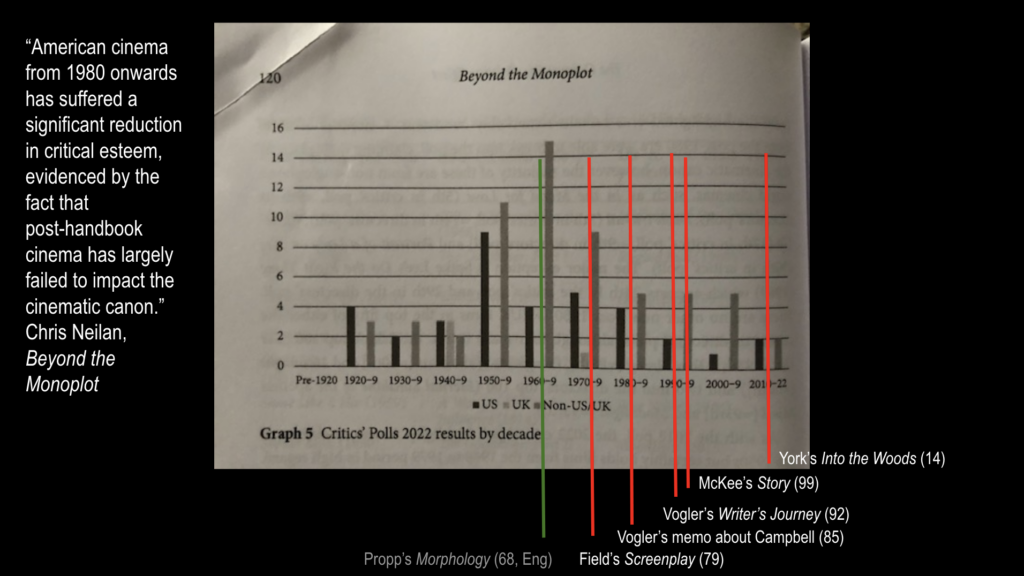
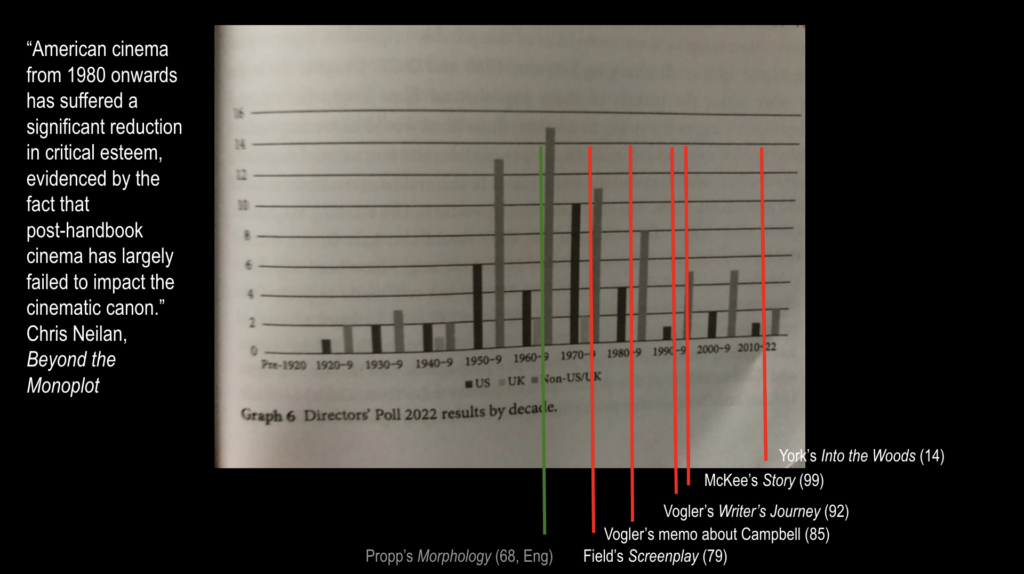
Design orthodoxy makes big claims about the proper way to create, and dissuades you from using other methods by framing them as the opposite of good, worthy, and valuable. In his book Beyond the Monoplot, screenwriter, teacher, and researcher Chris Neilan presents his quantitative analysis of critical consensus and peer esteem of feature films from pre-1920 to 2022. He showed that there has not been a significant increase in quality since the introduction of the methods and techniques of story guru manuals. In fact, critical regard is much lower compared to screenwriting pre-orthodoxy. Also, Neilan showed that before design orthodoxy was popularised, feature films enjoyed both critical and box office success. Afterwards, you’re more likely to have one or the other. The story gurus created a self-fulfilling prophecy. Investment, funding, and script assessors often draw on design orthodoxy even though it doesn’t indicate quality, because they don’t yet know how else to examine the works. We need to explore and spread methods for assessing without stencils, and put back in what is important.
Pivot: Development rejects false binaries such as art versus commerce, impact or entertainment, and instead focuses on responsible resonance and transformation, and other areas of concern. (For example: Centre for Public Impact et al’s Good Storytelling for Systems Change; Felicia Rose Chavez’s Anti-Racist Writing Improvements Objectives; Harmony Labs’ Values-Distinct Audiences)
Design Orthodoxy Doesn’t Increase the Likelihood of Success
Design orthodoxy makes big, false claims. The fact is, formulaic methods and techniques do not make everyone’s project better. As screenwriter and screenwriting teacher Neil Landau says in his book, The Screenwriter’s Roadmap: “If there was an absolute formula, every screenplay would be brilliant—and we all know that’s not the case.” As novelist Samuel R. Delaney says of different approaches in Pocket Workshop: “Masterpieces have been written with both methods. Both methods have produced drivel.” An analysis of Australian film success found that novice filmmakers earned a higher international ROI (return on investment) compared with experienced filmmakers. The reason being experienced filmmakers tended to become confidently myopic and not recognise or adapt to new opportunities (Rossiter & Mastoris). Despite it’s claims, design orthodoxy hasn’t lifted all boats. We need to decenter one-size-fits-all approaches and nurture what actually aids mutual flourishing.
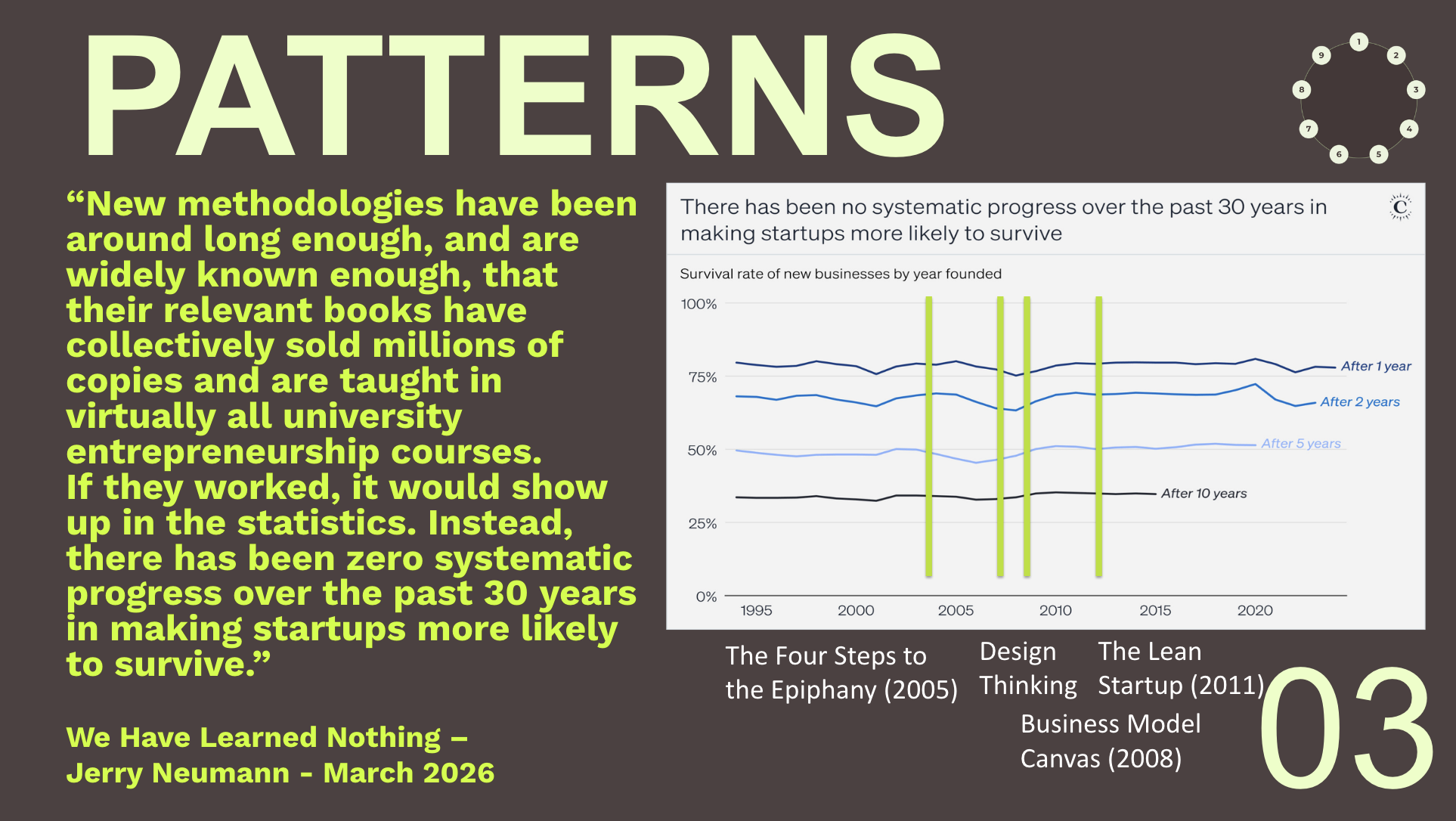
The lack of orthodoxy impact isn’t specific to creative productions. I attended Jane Korneyko’s talk at StartSpace a couple of months ago, and she detailed the research into how bestselling entrepreneur books (such as The Four Steps to Epiphany, Design Thinking, The Lean Startup, and the Business Model Canvas) have made zero impact on failure rates of startups. [Image below provided by Jane.]
A quote on her slide from Jerry Neumann (2026) says: “New methodologies have been around long enough, and are widely known enough, that their relevant books have collectively sold millions of copies and are taught in virtually all university entrepreneurship courses. If they worked, it would show up in the statistics. Instead, there has been zero systematic progress over the past 30 years in making startups more likely to survive.”
These are just some of the reasons why many of us are building a new story of creative development. There are more reasons why many of us are taking action, and more will keep emerging (tell me your reasons!). In the meantime, we’re building a new normal that is contextual, deliberate, impact-conscious, and about mutual flourishing…as a starting point.
How to cite this page:
Dena, Christy (2026) “Why We’re Changing the Story of Creative Development – Part 1,” Next World Narrative, 6 August. Last updated 11 August, 2026. www.nextworldnarrative.org/articles/why-were-changing-the-story-of-creative-development/
Library Updates: 1001 Faces, Liberation Wheel, and Beyond Victory Points
Here are the latest additions to our Liberatory Craft Library! Craft tools, inspiration, & insights for our next world. Some just remembered, some newly discovered.
📖 Books
👉 Albert Camus’ Create Dangerously
“Camus’s powerful lecture, as relevant today as ever, argues against ‘art for art’s sake’, while his Nobel Prize speech brilliantly sets out his vision of the artist’s role and responsibilities.”
👉 Damien John O’Meara’s Queer Stories in Australian TV drama: Production Culture, Policy, and Distribution
“This book examines how queer representations are negotiated by creatives and executives for distribution through mainstream television networks.”
👉 Ellen Kirkpatrick’s Recovering the Radical Promise of Superheroes: Unmaking Worlds (free & paid)
“Why, when set against otherwise unbounded, and often extreme, transformation—human to machine, human to animal, human to god—are certain categories seemingly untouchable?”
👉 Maria Tatar’s The Heroine with 1001 Faces
“The Heroine with 1,001 Faces dismantles the cult of warrior heroes, revealing a secret history of heroinism at the very heart of our collective cultural imagination.”
📜 Articles
👉 Alyssa Smith’s ‘Whitewashing v. Blackwashing: Structural Racism and Anti-Racist Praxis in Hollywood Cinema‘
“This study aims to dissect how whitewashing and blackwashing differ, as well as discuss how blackwashing succumbs to the racist history of the Hollywood film industry despite its attempt at leading a brighter future for Black representation in film.”
👉 Amber Case’s ‘How Design is Governance‘
“At a fundamental level, all design is governance. We encounter inconveniences like this coffee shop every day, both offline and in the apps we use. But it’s not enough to say it’s the result of bad design. It’s also a result of governance decisions made on behalf of the customers during the design process.”
👉 Amity Paye’s ‘Belief Arc‘
“What does it take to change people’s hearts and minds at scale? How do we meet people where they’re at, while staying laser-focused on where we want them to go?”
👉 Collective participants’ ‘Manifesto for Community Film Distribution and Exhibition in Latin America‘
“Collective Document Created by 183 Participants from 12 Countries at the III Latin American Forum on Film and Social Impact in Bogotá, Colombia, 2024.”
👉 DS4SI’s ‘No More Fairy Tales‘
“How do we go about telling ourselves the truth? How do we intervene in our own narrative devices? What stories have swallowed whole…about ourselves, about heroes and villains, about what it means to win? There is gut wrenching work to be done here.”
👉 Stayci Taylor’s ‘Not getting your story straight: queering heroes’ journeys and heteronormative timelines‘
“This article offers queer temporality as a lens through which to unravel the 12 steps of Vogler’s hero’s journey, informed by queer theory’s critiques of the 8 steps of the heteronormative life journey.”
👉 Quanice G. Floyd’s ‘We Need To Talk About Power & Control In The Arts And Culture Sector‘
“In this article, I’ll introduce the Arts & Culture Power and Control Wheel and the Arts & Culture Liberation Wheel. I’ll begin with the historical context behind the wheels before digging into the frameworks themselves.”
📺 Audio Visual
👉 Amabel Holland’s ‘Do Board Games Need Victory Conditions?‘
“Game designer Amabel Holland asks what kinds of human things the medium of board games can express and explore once we let go of winning or losing as sources of meaning.”
👉 James Dunlop’s ‘What the Gurus Leave Out‘
“If you’ve ever wondered whether successful writers possess secret knowledge (or simply a higher tolerance for ambiguity, repetition, and occasional self-doubt) this video may help.”
The Landscape of Narrative Design Activism
Many of us are reaching for change in ourselves and the world. We’re reaching for each other, and participating in positive social transformation.
We don’t just do this by protesting in the streets (though, this is important!). We do this in every aspect of lives. That donation? Sure. Petition? Yes. The conversation with your taxi driver, or rider? Yep. That policy change at your work? Ah-ha. That article you wrote? Yep! The stop work campaign you participated in? Yep! The diverse characters in the game, film, TV show, or novel you created? Yes. Every part of our lives is open to change.
Narrative design activism is about the action we take through the creative projects we put out into the world, and, importantly, how we make them.
It’s narrative design activism to highlight to overtly include change that is channeled into how we make (our games, films, TV shows, novels, plays, and more*). This is because it isn’t always part of creative activism. Let me explain.
Creatives can be activists in some or all parts of their life and practice. There are areas that people default to putting their energy into more than others. To help illustrate this, I’ve listed patterns I’ve noticed. (Let me know your thoughts!)
Everyday not Entertainment
I know plenty of creatives who are activists about issues (such as changing for the climate and social inequalities), to various degrees, in their everyday, and not with their creative work. Sometimes this separation is unconscious because they learnt to silo different parts of their self (that was me!). Sometimes it is a deliberate split because they will risk their livelihood and their lives. Sometimes it is a deliberate split because they’ve erroneously been taught that design is not part of life. Sometimes it is a deliberate separation because while they know their creative work is oppressive and uninspiring, they need the income of conventional design work. Sometimes it is deliberate because they want to maintain an oppressive status quo in a creative industry that benefits them, or promises to.
Faces not Forms
There are those that see their their characters depicted, casting, and crew as activism (whether it is fiction or non-fiction), and they still employ design orthodoxy to make their projects. See Henry Lien’s “Diverse Story Forms and Themes, Not Just Diverse Faces.” This is when folks make hard-won inrounds to having a seat at the table, despite the bias and pushback. This is also seen with initiatives where marginalised folks gain entry to the industry through special programmes, or are given their own niche events & audiences. The idea being that the creative changes to fit the industry, not the industry changes to include all of who they are. Sometimes this is an unconscious separation because they’ve erroneously been taught that they only have agency with implementation, not every aspect of design. Sometimes this is a conscious separation because while they know their creative work is maintaining orthodoxy, it is the only element gatekeepers/stakeholders would approve and they know it is making a contribution anyway. Or, inversely, they wanted it to maintain orthodoxy but they were “forced” to include diverse characters, storylines, cast, and/or crew. Sometimes it is deliberate because the creatives want to maintain an unequal status quo for their benefit, or the promise of one, while also benefitting from being seen as progressive. See greenwashing, pinkwashing, blackwashing, etc.
These latter folks are often on funding/investment panels because of their activism, but they find a way to “reluctantly” reject projects with diverse forms, goals, & audiences. I despair at how common this is. But, I also know that they were taught (by society and creative projects!) that unequal treatment is the only way to survive this world. Our activism needs to include their liberation as well.
Industry not Practice
There are also creatives who aren’t using their creative works or their processes for activism, but take action about their industry to try and make things better. They take action on workers’ rights, pay rates, content quotas, open access publishing, respect for different roles, reaching audiences, and so on. Sometimes this is a first foray into activism and is appealing because of the potential personal (or group) benefit and the support of peers. It can be an onboarding to doing more. Sometimes these folks keep the separation because they want to contribute to change while (for the promise of income security) maintaining their professional status with studios and their oppressive practices. Sometimes these folks want to keep enacting and benefiting from oppressive creative practices, and also be seen as progressive. Sometimes there is this separation because they’ve erroneously been taught that design doesn’t change, only the industry around it. Sometimes there is this separation because they’ve erroneously been taught that creativity is about certainty, and so it is best they stick to the design they know.
Impact Documentary not Impact Entertainment
There are creatives and stakeholders who take action with the stories they tell, the design process, and their audiences, but only in documentary, education-based works, and serious games, not entertainment in general. Sometimes this separation is because creatives and stakeholders have been erroneously been taught that people don’t learn from entertainment. Some of the most impactful films, TV shows, and games were not made for impact. Take Jaws as an example, and it’s impact on shark policy and public fear of deep water (and for me, dipping my toe on the floor from my bed). Sometimes there is this separation because funders are limited by government policies that don’t allow them to invest in anything other than hedonism. Sometimes this is this split because investors have been erroneously taught that creative orthodoxy is the only market. Sometimes there is this split because creatives who work in entertainment fear they won’t be taken as seriously by their activist peers. Sometimes there is this split because creatives haven’t yet learnt how to be responsible with their design and make something undeniably entertaining.
Status Quo not Structure
There are people, including activists, who aren’t working creatives but who use storytelling in their campaign speeches, videos, and even use existing creative projects. More often than not, despite their goals of changing the status quo, they often use status quo design. Sometimes this separation is because design orthodoxy is what reaches them. Design orthodoxy is uplifted by the status quo and so reaches newcomers and those who aren’t inartistic professions. But, it needs to be said, design orthodoxy is not what many creatives work with, and their skewed representations of craft have been the subject of design activism within screenwriting, playwrighting, literature, as soon as the new oppressions were invented. Sometimes this split is because they’ve been erroneously told by trusted creatives who themselves have been misled about how design works. Sometimes there is this split because they’ve erroneously been taught that orthodoxy is the only entertainment market, even though there are activists sharing data on different designs for different audiences. Sometimes this is because the activists have taken on the oppressive ideas informing in design orthodoxy, and so they don’t see any contradiction.
Attuned without Accountability
There are creatives who are activists about the processes, methods, and techniques to the extent it frees them to design their way. This often excludes any interest engaging with prosocial design (in their fiction or non-fiction, or even in their peer relationships), or for social change goals. Sometimes this separation is because the issue with design orthodoxy isn’t just that it is anti-progressive, it’s that it thwarts most peoples’ creativity full stop. Sometimes this separation is because finding a process attuned to them is their first step on a journey of creative liberation. Sometimes there is a deliberate separation because they want to maintain and benefit from creative orthodoxy, but they personally can’t do conventional processes. Sometimes the split is because they crave novelty but they loudest voices around them steer that interest in the direction of a selfish status quo.
Aligned Practice
There are creatives that don’t silo their activism but instead continously attend to it, to the best of their ability, where they can, in every aspect of their creative and personal life. This is the least common because of impediments mentioned above.
I’ve been through every one of these areas of focus and I’ve found that what helps me align all of them. (Which doesn’t mean I’m perfect at all!) I’ll quickly share what that is rather than leaving the conversation there!
Narrative change activists talk about it, and so too do system change designers, and information communication researchers, among others. It’s got various names, including a “deep narrative,” “mindset,” “cultural narrative,” “paradigm.” This repetition doesn’t mean it is right and always will be. It means that there is a community of interest around it, lots of energy being put into it, and it resonates with me.
It’s about the underlying, cultural stories we tell ourselves about how the world works. It gives us the deep logic — the underlying worldbuilding or theme in writing terms — that contribute to what we do in our everyday, with our peers, our craft processes, the structures and mechanics we use, what we make, and so on.
I find that attending to deep narratives gives me a continuity of practice and cumulative insights.
I’ll be sharing the work people have done in this space and my own, too. I’m running a workshop on the restricting and liberating deep narratives that inform how we talk about craft, and will be sharing more in other formats as well. I’d love to hear your thoughts!
* There are those in games familiar with the term “narrative designer” as a noun to describe a job which involves, among other things, being a ‘team synthesist;’ playwrights familiar with the term “dramaturg,” which involves, among other things, attending to the meanings of the collective representations; and literary writers familiar with the term “narrative design” to include the form work of writing. I’m using the term less as a noun and more to denote the focus on designing. With the emphasis on the various meanings (narratives) associated with our design work on teams, industries, cultures, and more.

How to cite this page:
Dena, Christy (2026) “The Landscape of Narrative Design Activism,” Next World Narrative, 23 June. Last updated 22 July, 2026. www.nextworldnarrative.org/articles-2/the-landscape-of-narrative-design-activism/
Thank you to Heidi and Richard for your contributions!
Library Updates – De-Coupling, Exercises, Transformative, Impact
Here are the latest additions to our Liberatory Craft Library! Some just realised, some newly discovered or recommended, and some just remembered.
✊ Why do this? We’re guided by mutual flourishing: which means recognising that this is collective work and we’re all responsible for co-making our creative cultures and the world.
📜 Articles
👉 Ivan Pintor Iranzo’s “From Rhetoric to Archetype: Screenwriting Manuals”
“in what ways do screenwriting manuals and analytical studies complement each other and how do they exchange contributions?”
👉 Shane Agid’s “How What We Ask Shapes What We Can Imagine: De-Coupling Design and Punishment”
“I focus on what shaped these questions, and how the questions in turn shaped the possibilities for design that emerged from them, in ways that matter deeply to the imbrication of architecture, design, and punishment.”
📖 Books
👉 Lucy Ives’ Three Six Five: Prompts, Acts, Divinations
“Many exercises take the form of play, encourage collaboration with friends, strangers, and non-human beings, and operate off the page, often in the world, in the spirit of discovery rather than result.”
👉 Sarah Lynne Bowman, Kjell Hedgard Hugaas, and Simon Brind (Eds)’s Implementing Transformative Role-playing Games, Uppsala University
“This textbook explores implementation practices for running transformative analog role-playing games, such as transformative leisure, educational, and therapeutic applications.”
📺 Audio Visual
Victor Navarro Remesal’s talk “The Making of Zen and Slow Games”, Center for Digital Play, IT-Universitetet i København
🔖 Reports & Guides
👉 Kemi Alabi et al’s “Building Irresistible Movements: Best Collaboration Practices for Organizations and Visual Artists”
“How can organizers and artists best work together to harness the power of culture and create a more just world?” (through Monica trinidad’s ace Youtube video “Artists are workers | getting paid to make art for social change” https://lnkd.in/gR4KCJxB)
👉 OKRE & UKIE’s “Building a Unified Framework For UK Video Games Impacts”
“It provides research frameworks for the sector’s wide ranging impacts along with a reframed sector definition and interactive supply chain visualisation.”
👉 UNESCO‘s “Re|Shaping Policies for Creativity: we share, we act, we build”
“Digital transformation has fundamentally reshaped the creative landscape. Never has creative content been so abundant, nor the tools so widely accessible. Yet for many, stable employment and fair pay are out of reach. … These challenges urgently call for collaborative global governance.”
Explore these and more in the Liberatory Craft Library. 🙂
A Narrative Design Activist’s Primer To Talking About Craft
[This is preparation reading for the “Bad Story Guru Medicine” workshop!]
Many of us love the challenge of creating something we imagine.
Many of us also love to contribute to positive social change through what we create.
We can also be imaginative in how we create and how we contribute to change.
We can put effort into designing how we design, and in most cases we need to.
Applying creativity to our processes is not straightforward, though. This is because of the common ways design is framed. For instance, how we justify a structure, the reasons we give for using a technique, and how we explain design and the world, in general.
It’s often a framing that says we can’t change design and we can’t be a part of changing the world.
These anti-liberatory framings, and others, are spread by just about all us. I know I have.
At the very least, you’d have colleagues and stakeholders who pre-emptively insist that you can’t do that and you can only do this.
Often they feel emboldended because their framing is echoed, or first heard, in popular manuals (screenwriting, writing, game design, etc) authored by “story gurus.”
What Does “Story Guru” Mean?
By “story guru,” I mean the definition Bridget Conor uses: where it refers to the authors of screenwriting manuals who are the most widely cited. “Design guru” is a term, too, and applies to those in games, product design, and so on. I’m referring to all of them, really.
But I’ll note that screenwriting gurus have been big part of the conversation for a lot of people in film, TV, and games. You can’t throw a search query without their books or someone repeating the ideas of their books coming up.
Of concern for us here is less the narrative techniques and methods they encourage, necessarily, it’s the way they frame craft, design, creativity, you the creative, the industry, the world.
While story gurus can vary in the structure they put foward, most use the same strategic framings.
This is an issue because many creatives are self-taught. The recent Olsberg SPI & Screen Australia Capacity Report documents this for film, TV, and games. The increasing fees at education institutions, course closures, and declining enrolments are all part of this.
While unfruitful and oppressive framings of design can definitely be taught at institutions, they’re rife online and at industry initiatives targeting newcomers. This is in part because those newcomers don’t yet know any better.
In her newsletter, ex-screenwriter and literary manager, Audrey Knox, says: “Writers need community. But seeking support from strangers on the internet will result in surrounding yourself with misinformation, discouragement, bad advice, and despair.”
There are plenty of good communities and advice to be found online (here lol!), but, yes, misinformation is rife.
Since we’re all always new to something, though, the solution isn’t becoming experts at everything.
We need a way to get better at identifying misinformation even when we don’t have knowledge and experience in the area of practice. More on this shortly. For now we’re attending to the ‘who’ of misinformation.
Who Misinforms?
We’ve all shared misinformation at some time. We’ve shared advice that isn’t true and doesn’t help others.
I have many times (and will again!). One example is when I was teaching interactive storytelling to film, games, animation, and multimedia students. I carefully curated multiple story structures. I gave the students many options and ways to choose them. Great! But I also claimed they have that freedom as long as they stick to some core underlying structural beats. In other words, I said there are some parts of design that can’t change. (This was due to the influence of a specific story system I ingested that won’t share here because I’m not sure if you’re immune to their tactics, yet!)
I wasn’t trying to mis-inform my fellow creatives, and the structures I shared were helpful! But I spread a core misrepresentation of design because I believed it was true. Indeed, I thought the information would have positive consequences on their craft.
Some of us share craft misinformation because we believe it or we don’t realise we’re causing harm.
It is also true that some people share craft misinformation as a tactic…because they mean it.
It’s important to understand this because it informs how we address the issue. If we think misinformation spreads because we simply don’t realise what it is doing, then we’ll assume that explaining how a framing is oppressive will automatically stop the problem.
It won’t. Some people keep doing it no matter the consequences.
This is why my online workshop is called “Bad Story Guru Medicine.”
But How Do They “Mean It”?
You’ll likely be aware of the distinction between disinformation and misinformation: between people who are manipulating and those who share the ideas because they have internalised them.
How do we know someone is doing misinformation or disinformation?
A good check is whether the tactics are actively maintained or even increased over time.
You see, nothing is fixed. My practice has changed. I change as I learn more from others and myself. But there are some folks who no matter how many times they make things (if they still make creative projects), and no matter how many people challenge them (there are always challenges), and no matter how much the landscape changes, they actively maintain their tactics. (Peter Berger and Thomas Luckmann call this “universe maintenance.”)
We can infer intent when folks continue to use the same tactics across multiple editions, publications, courses, and they even expand the kinds of bad tactics they use (Chris Neilan will talk this in an upcoming publication).
Bad medicine is treating transformation as one-way.
I don’t think some folks mean to cause the consequences, though.
I don’t think they’re lying to me about creative practice, either.
A person who helped me with this is author Harry Frankfurt. He makes a distinction between a liar and a bullshitter. (Coincidentally, John August refers to Frankfurt’s book, called On Bullshit, in a recent Script Notes podcast — for a different reason.)
Frankfurt explains that the liar doesn’t want you to find the truth. They try to conceal and distract you from it.
The bullshitter, on the other hand, doesn’t care about the truth. The bullshitter says things that are true and untrue! They don’t care about describing reality, just whether it serves their purpose.
Frankfurt explains that both the liar and the bullshitter falsely present themselves as communicating the truth.
Both the liar and the bullshitter are united in their aim to get away with something.
So this is what sits better with me: A lot of story gurus aren’t trying to oppress us by leading us away from our creative agency. They just don’t care about what really helps us, only what helps them.
Shane Littrell’s work on bullshitting is relevant here, too. He says that bullshitting is functionally misleading (which is how all of us can participate in it even if we don’t intend to — just communicating something untrue has the effect of misleading).
He also says that bullshitting is epistemically irresponsible (careless with knowledge), in that it is ‘constructed to sound superficially smart, impressive, or otherwise persuasive without genuinely being accurate, meaningful, or informative.’
Bad medicine is impression management at the cost of others.
It’s disinformation when the story guru benefits at the cost of others…the cost of the creatives they’re claiming to help…and the planet.
Bad medicine is about non-mutual flourishing.
With this, what makes anything we unintentionally mis-inform others with is not just that it’s ‘untrue,’ but more so that the information corrupts our relationship with our practice, each other, and ourselves.
Misinformation is a mis-relation.
This is why I call it “bad medicine.”
It’s not good for you, me, or them.
What To Do About It
The usual approach is mythbusting.
When I grew frustrated with hearing craft misinformation repeated again and again, I felt the need to explain why that stuff is a myth.
Thankfully, before I did that, I learnt from George Lakoff’s book, Don’t Think of an Elephant!, that mythbusting doesn’t work. Why? Common mythbusting is about naming the myth and then explaining why it isn’t true. With that approach, you end up repeating their framing of the issue. Saying ‘don’t think of an elephant’ gets us thinking of an elephant.
Mythbusting centres their way of seeing the world, their way of seeing craft.
An intervention Lakoff recommends is a truth sandwich: Always start with the truth, then go to the myth, and then return to the truth. I used this method when I gave a talk on liberatory narrative design at a games conference, and explained why I was doing it.
Lakoff also says it’s important to start with your values. Activists draw on these insights. They frame their campaigns and frame conversations based on what is important to them and their audiences. Creative freedom? Adaptability? Etc. I try to remember this, too.
One thing I also tried was designing my classes and production meetings around liberatory design thinking and practices. I created an alternate world without the misinformation (to the best of my understanding at the time!).
A liberatory approach to design creates a way out of that thinking, but I found it also doesn’t stop craft misinformation.
Just being exposed to different ways of making did not stop my colleagues being susceptible to it (like I was). Studies have shown this, too: that just being exposed to accurate messages is not the most effective way to stop inaccurate messages.
Leading with values gets us closer because it focuses on the relationship part. Not truth, but relations.
So, I think we need to:
- Determine what framings of craft are anti-liberatory, which are about non-mutual flourishing.
- Develop responses that don’t uphold these framings but instead bring us closer to what is important to us.
Leading with Mutual Flourishing
To make non-mutual flourishing, to make mis-relations, obsolete, we need to be deliberate in our relationships with our colleagues, design, ourselves…and story gurus. We can’t treat story gurus as they’ve treated us. I don’t want to call them “bad story gurus” as that is doing the same they’ve done to me. (This is why my emphasis is on “bad story guru medicine.“)
As educator Paulo Freire said in Portuguese originally, ‘In order for this struggle to have meaning, the oppressed must not, in seeking to regain their humanity (which is a way to create it), become in turn oppressors of the oppressors, but rather restorers of the humanity of both.’
Our relationships with each other are the crux of the issue and the way through. Here are some fellow thinkers in this work:
In Medicine Stories, Aurora Levins Morales says:
The ecological crisis we find ourselves in is in fact a crisis of human relations, with each other and with the entire planet. It is a crisis created by a set of false assumptions about reality, the same assumptions that drive all systems of oppression.
In White Supremacy Culture, Tema Okun says this:
The invitation on this and every page is to investigate how these characteristics and qualities lead to disconnection (from each other, ourselves, and all living things) and how the antidotes can support us to reconnect.
In Right Story, Wrong Story, Tyson Yunkaporta says this:
Right story is not about objective truth.’ ‘Right story,’ he continues, ‘never comes from individuals, but from groups living in right relation with each other and with the land.
Good medicine is about good relations, between the craft advisor and us (we’re all advisors and learners).
How We’ll Do It
I’m experimenting with an approach that explains the title of the workshop: bad story guru medicine.
- We’ll take on the role of the bad story guru.
- We’ll use deep cultural narratives and tactics to achieve our goal of non-mutual flourishing.
- We’ll then look at ways to operate differently, with mutual flourishing guiding us.
Why? Why do this even though we don’t want to treat story gurus as the bad guys?!
Well, as I mentioned earlier: just focusing on mutual flourishing is doesn’t stop susceptibility to misinformation. And there are folks who will persist with the tactics even when they know they’re bad.
So, with the ‘bad story guru medicine’ approach, we not only develop our understanding of corruptive framings (how we’re manipulated), we also understand that there is a who of bad medicine (them and us).
We’ll playfully do it from the perspective of the person who is not concerned with the flourishing of others as much as themselves. We do this to see how easy it is to slip into these tactics, how easy it is to be taken in by them, to understand that this is a human issue, that there are people making these choices, to understand reasons for spreading misinformation (intentionally and not), and to motivate us to do it differently.
We’ll be looking at corruptive framings that are predictable and repeated across multiple sectors (multiple artforms, industries, and aspects of life). So that when we address it in our craft, we’re also more likely to address it in many aspects of our life.
Importantly, we’ll go into the details of how we frame design for mutual flourishing.
We’ll also be doing this in a collective conversational manner, as this work can flourish when it is bottom-up and community-focused.
We’ll develop our good relations with each other as a start.
How to cite this page:
Dena, Christy (2026) “A Narrative Design Activist’s Primer To Talking About Craft,” Next World Narrative, 3 June. Last updated 21 June, 2026. www.nextworldnarrative.org/articles/how-to-effectively-do-myth-busting/
Connecting the Mutual Flourishing Story System
Yay! I’ve joined StartSpace for a year to test the creation of a new service that helps audiences discover prosocial films, TV shows, and games, and helps their creators of such projects connect with their market.
While it is now common sense that there are multiple audience segments, there is still a lot of investment and promotion channelled into stories of superiority.
For a few years, I’ve been noodling on a way to help both sides (audiences and creators).
While I’ve been pitching and getting funding for creative projects, one of the things that helps the process is having an established route to your audience. So, while I’m putting time and effort into designing my own prosocial projects and contributing to enhanced capabilities of fellow creatives with Next World Narrative, I’m also looking at the audience connection side.
“In order for stories to contribute to systems change, energy needs to be spent on both the supply and the demand sides of the equation. In other words, we need to understand both how to support people to tell better stories and how to increase the likelihood that there is an audience ready and willing to hear and respond to the stories.” (Snow et al, Storytelling for Systems Change: Insights from the field)
I, and many others, know there is an audience for prosocial characters and mechanics. It’s been proven over and over again. What can help is having another route to connecting audiences with these projects.
If you’re working in this space, message me! I’d love to connect! 😀