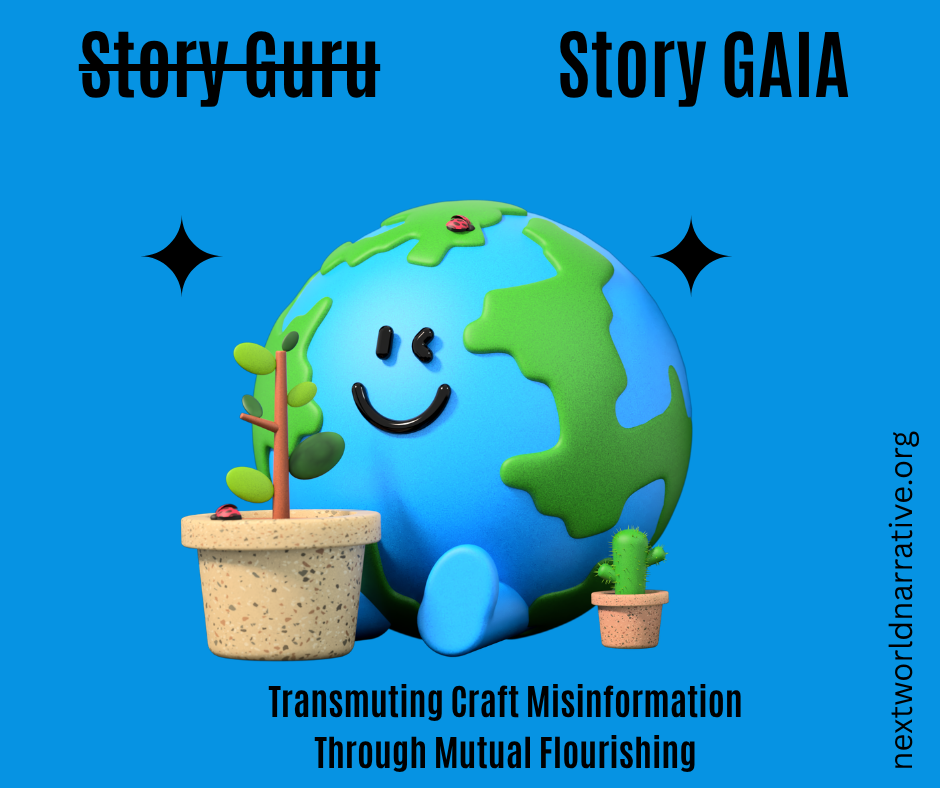
[This is preparation reading for the “Bad Story Guru Medicine” workshop!]
Many of us love the challenge of creating something we imagine.
Many of us also love to contribute to positive social change through what we create.
We can also be imaginative in how we create and how we contribute to change.
We can put effort into designing how we design, and in most cases we need to.
Applying creativity to our processes is not straightforward, though. This is because of the common ways design is framed. For instance, how we justify a structure, the reasons we give for using a technique, and how we explain design and the world, in general.
It’s often a framing that says we can’t change design and we can’t be a part of changing the world.
These anti-liberatory framings, and others, are spread by just about all us. I know I have.
At the very least, you’d have colleagues and stakeholders who pre-emptively insist that you can’t do that and you can only do this.
Often they feel emboldended because their framing is echoed, or first heard, in popular manuals (screenwriting, writing, game design, etc) authored by “story gurus.”
What Does “Story Guru” Mean?
By “story guru,” I mean the definition Bridget Conor uses: where it refers to the authors of screenwriting manuals who are the most widely cited. “Design guru” is a term, too, and applies to those in games, product design, and so on. I’m referring to all of them, really.
But I’ll note that screenwriting gurus have been big part of the conversation for a lot of people in film, TV, and games. You can’t throw a search query without their books or someone repeating the ideas of their books coming up.
Of concern for us here is less the narrative techniques and methods they encourage, necessarily, it’s the way they frame craft, design, creativity, you the creative, the industry, the world.
While story gurus can vary in the structure they put foward, most use the same strategic framings.
This is an issue because many creatives are self-taught. The recent Olsberg SPI & Screen Australia Capacity Report documents this for film, TV, and games. The increasing fees at education institutions, course closures, and declining enrolments are all part of this.
While unfruitful and oppressive framings of design can definitely be taught at institutions, they’re rife online and at industry initiatives targeting newcomers. This is in part because those newcomers don’t yet know any better.
In her newsletter, ex-screenwriter and literary manager, Audrey Knox, says: “Writers need community. But seeking support from strangers on the internet will result in surrounding yourself with misinformation, discouragement, bad advice, and despair.”
There are plenty of good communities and advice to be found online (here lol!), but, yes, misinformation is rife.
Since we’re all always new to something, though, the solution isn’t becoming experts at everything.
We need a way to get better at identifying misinformation even when we don’t have knowledge and experience in the area of practice. More on this shortly. For now we’re attending to the ‘who’ of misinformation.
Who Misinforms?
We’ve all shared misinformation at some time. We’ve shared advice that isn’t true and doesn’t help others.
I have many times (and will again!). One example is when I was teaching interactive storytelling to film, games, animation, and multimedia students. I carefully curated multiple story structures. I gave the students many options and ways to choose them. Great! But I also claimed they have that freedom as long as they stick to some core underlying structural beats. In other words, I said there are some parts of design that can’t change. (This was due to the influence of a specific story system I ingested that won’t share here because I’m not sure if you’re immune to their tactics, yet!)
I wasn’t trying to mis-inform my fellow creatives, and the structures I shared were helpful! But I spread a core misrepresentation of design because I believed it was true. Indeed, I thought the information would have positive consequences on their craft.
Some of us share craft misinformation because we believe it or we don’t realise we’re causing harm.
It is also true that some people share craft misinformation as a tactic…because they mean it.
It’s important to understand this because it informs how we address the issue. If we think misinformation spreads because we simply don’t realise what it is doing, then we’ll assume that explaining how a framing is oppressive will automatically stop the problem.
It won’t. Some people keep doing it no matter the consequences.
This is why my online workshop is called “Bad Story Guru Medicine.”
But How Do They “Mean It”?
You’ll likely be aware of the distinction between disinformation and misinformation: between people who are manipulating and those who share the ideas because they have internalised them.
How do we know someone is doing misinformation or disinformation?
A good check is whether the tactics are actively maintained or even increased over time.
You see, nothing is fixed. My practice has changed. I change as I learn more from others and myself. But there are some folks who no matter how many times they make things (if they still make creative projects), and no matter how many people challenge them (there are always challenges), and no matter how much the landscape changes, they actively maintain their tactics. (Peter Berger and Thomas Luckmann call this “universe maintenance.”)
We can infer intent when folks continue to use the same tactics across multiple editions, publications, courses, and they even expand the kinds of bad tactics they use (Chris Neilan will talk this in an upcoming publication).
Bad medicine is treating transformation as one-way.
I don’t think some folks mean to cause the consequences, though.
I don’t think they’re lying to me about creative practice, either.
A person who helped me with this is author Harry Frankfurt. He makes a distinction between a liar and a bullshitter. (Coincidentally, John August refers to Frankfurt’s book, called On Bullshit, in a recent Script Notes podcast — for a different reason.)
Frankfurt explains that the liar doesn’t want you to find the truth. They try to conceal and distract you from it.
The bullshitter, on the other hand, doesn’t care about the truth. The bullshitter says things that are true and untrue! They don’t care about describing reality, just whether it serves their purpose.
Frankfurt explains that both the liar and the bullshitter falsely present themselves as communicating the truth.
Both the liar and the bullshitter are united in their aim to get away with something.
So this is what sits better with me: A lot of story gurus aren’t trying to oppress us by leading us away from our creative agency. They just don’t care about what really helps us, only what helps them.
Shane Littrell’s work on bullshitting is relevant here, too. He says that bullshitting is functionally misleading (which is how all of us can participate in it even if we don’t intend to — just communicating something untrue has the effect of misleading).
He also says that bullshitting is epistemically irresponsible (careless with knowledge), in that it is ‘constructed to sound superficially smart, impressive, or otherwise persuasive without genuinely being accurate, meaningful, or informative.’
Bad medicine is impression management at the cost of others.
It’s disinformation when the story guru benefits at the cost of others…the cost of the creatives they’re claiming to help…and the planet.
Bad medicine is about non-mutual flourishing.
With this, what makes anything we unintentionally mis-inform others with is not just that it’s ‘untrue,’ but more so that the information corrupts our relationship with our practice, each other, and ourselves.
Misinformation is a mis-relation.
This is why I call it “bad medicine.”
It’s not good for you, me, or them.
What To Do About It
The usual approach is mythbusting.
When I grew frustrated with hearing craft misinformation repeated again and again, I felt the need to explain why that stuff is a myth.
Thankfully, before I did that, I learnt from George Lakoff’s book, Don’t Think of an Elephant!, that mythbusting doesn’t work. Why? Common mythbusting is about naming the myth and then explaining why it isn’t true. With that approach, you end up repeating their framing of the issue. Saying ‘don’t think of an elephant’ gets us thinking of an elephant.
Mythbusting centres their way of seeing the world, their way of seeing craft.
An intervention Lakoff recommends is a truth sandwich: Always start with the truth, then go to the myth, and then return to the truth. I used this method when I gave a talk on liberatory narrative design at a games conference, and explained why I was doing it.
Lakoff also says it’s important to start with your values. Activists draw on these insights. They frame their campaigns and frame conversations based on what is important to them and their audiences. Creative freedom? Adaptability? Etc. I try to remember this, too.
One thing I also tried was designing my classes and production meetings around liberatory design thinking and practices. I created an alternate world without the misinformation (to the best of my understanding at the time!).
A liberatory approach to design creates a way out of that thinking, but I found it also doesn’t stop craft misinformation.
Just being exposed to different ways of making did not stop my colleagues being susceptible to it (like I was). Studies have shown this, too: that just being exposed to accurate messages is not the most effective way to stop inaccurate messages.
Leading with values gets us closer because it focuses on the relationship part. Not truth, but relations.
So, I think we need to:
- Determine what framings of craft are anti-liberatory, which are about non-mutual flourishing.
- Develop responses that don’t uphold these framings but instead bring us closer to what is important to us.
Leading with Mutual Flourishing
To make non-mutual flourishing, to make mis-relations, obsolete, we need to be deliberate in our relationships with our colleagues, design, ourselves…and story gurus. We can’t treat story gurus as they’ve treated us. I don’t want to call them “bad story gurus” as that is doing the same they’ve done to me. (This is why my emphasis is on “bad story guru medicine.“)
As educator Paulo Freire said in Portuguese originally, ‘In order for this struggle to have meaning, the oppressed must not, in seeking to regain their humanity (which is a way to create it), become in turn oppressors of the oppressors, but rather restorers of the humanity of both.’
Our relationships with each other are the crux of the issue and the way through. Here are some fellow thinkers in this work:
In Medicine Stories, Aurora Levins Morales says:
The ecological crisis we find ourselves in is in fact a crisis of human relations, with each other and with the entire planet. It is a crisis created by a set of false assumptions about reality, the same assumptions that drive all systems of oppression.
In White Supremacy Culture, Tema Okun says this:
The invitation on this and every page is to investigate how these characteristics and qualities lead to disconnection (from each other, ourselves, and all living things) and how the antidotes can support us to reconnect.
In Right Story, Wrong Story, Tyson Yunkaporta says this:
Right story is not about objective truth.’ ‘Right story,’ he continues, ‘never comes from individuals, but from groups living in right relation with each other and with the land.
Good medicine is about good relations, between the craft advisor and us (we’re all advisors and learners).
How We’ll Do It
I’m experimenting with an approach that explains the title of the workshop: bad story guru medicine.
- We’ll take on the role of the bad story guru.
- We’ll use deep cultural narratives and tactics to achieve our goal of non-mutual flourishing.
- We’ll then look at ways to operate differently, with mutual flourishing guiding us.
Why? Why do this even though we don’t want to treat story gurus as the bad guys?!
Well, as I mentioned earlier: just focusing on mutual flourishing is doesn’t stop susceptibility to misinformation. And there are folks who will persist with the tactics even when they know they’re bad.
So, with the ‘bad story guru medicine’ approach, we not only develop our understanding of corruptive framings (how we’re manipulated), we also understand that there is a who of bad medicine (them and us).
We’ll playfully do it from the perspective of the person who is not concerned with the flourishing of others as much as themselves. We do this to see how easy it is to slip into these tactics, how easy it is to be taken in by them, to understand that this is a human issue, that there are people making these choices, to understand reasons for spreading misinformation (intentionally and not), and to motivate us to do it differently.
We’ll be looking at corruptive framings that are predictable and repeated across multiple sectors (multiple artforms, industries, and aspects of life). So that when we address it in our craft, we’re also more likely to address it in many aspects of our life.
Importantly, we’ll go into the details of how we frame design for mutual flourishing.
We’ll also be doing this in a collective conversational manner, as this work can flourish when it is bottom-up and community-focused.
We’ll develop our good relations with each other as a start.
How to cite this page:
Dena, Christy (2026) “A Narrative Design Activist’s Primer To Talking About Craft,” Next World Narrative, 3 June. Last updated 21 June, 2026. www.nextworldnarrative.org/articles/how-to-effectively-do-myth-busting/