I went to an improv session on the weekend. Jamie gave us an exercise where we offer our partner something to do together (for instance, “let’s go to a rock band concert”). If our partner said yes, we’d improvise being at a concert together. If our partner said no, we’d try another offer. Our task was to notice our partner’s response. How did they say yes or no? Did their eyes light up? Did they close down? I noticed that whenever they said ‘no,’ I loved it. Not that I preferred a no to a yes. A yes gives information about what they like and love. A no lets me know what doesn’t bring them alive. A no helps me get to know them.
I’ll share something about my brain with you. I automatically think about future trajectories based on present and past information. A new bit of information and the trajectories shift. I learnt to hide this way of thinking. If I mentioned how action X could lead to outcome Y, people would screw their face up. It seems some folks have no conception of how a mind could do that. They assumed I must be acting according to their world logic: I must be making big, false, claims about something I couldn’t possibly know. I must be paranoid. I must think I could do magic. I knew the steps along the trajectory, so their views didn’t change my mind about the insight. They did, however, for a time, contribute to me not sharing my thoughts. I may have done this to avoid disdain. I know I did this because I had no idea how to explain that my world is different to theirs. It’s not magic or some superpower. It’s as regular as my cup of tea, and lots of people drink tea.
Time isn’t one-way, either. I looked back to the past for explanations of the present. I remember when I was a teenager. One day, mid-afternoon, I suddenly felt despondent and self-loathing (more so than usual lol). I knew I didn’t feel that way when I woke up, so I traced my steps through the day. I realised that the negative thoughts and feelings emerged after reading Dolly Magazine (it was different then). I stopped reading those teen magazines. I had a little less prodding me feel unnecessarily down about myself.
When I was teaching interactive storytelling, game design, screenwriting, whatever subject it was, I noticed how students responded. I learnt what happens when I teach this way and that way. If I change the game design props from a chess board to plants, the nature of the games they make are considerably different. Then, later in the course, the kinds of games they pitched changed, and so on. I made new offers, learnt new paths, and gradually built new trajectories. I thought about the offers they got from teachers in other courses, and from fellow workers after university. Peers who will be hellbent on saying bullshit like money is the only reality, professionals must ghost people, and so on. I thought, what I can offer now that might stay with them in the future. I don’t define their future. But knowing what is highly likely to be coming, I can give them a different present. A present that lets them know they don’t have to go with what they’re offered. A present that encourages them to know what brings them alive and closes them down.
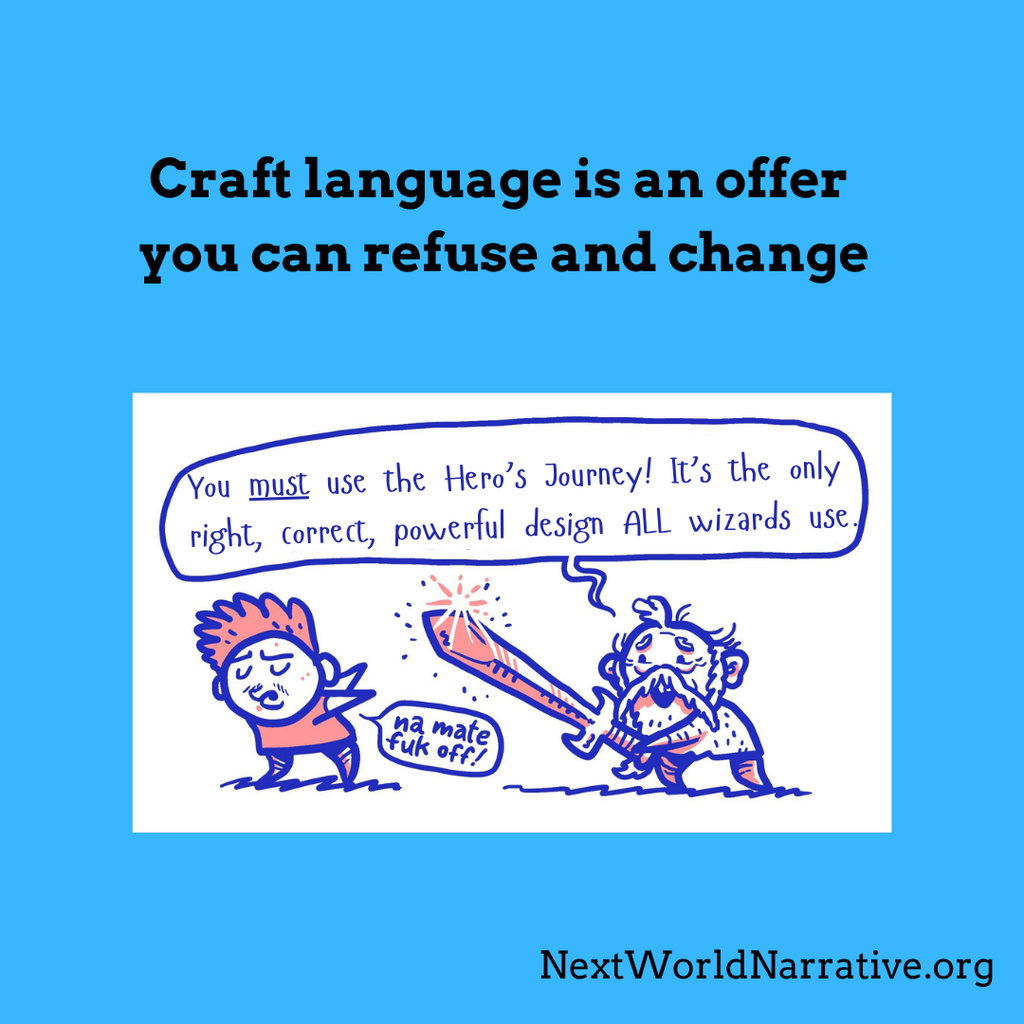
We don’t have to say yes to craft methods that don’t bring us alive. We can say no to their premise that design is fixed and we have no say in it. We can say no to their claims about the urgency of it all, and how their designs are the only way to be professional. In Strike!, documentary maker, historian and activist Jeremy Brecher details the history of (American) worker strikes. ‘If they refuse to work,’ he explains, ‘withdraw their cooperation, or take control of their own activity, “they have the power to reshape society.”’ Refusal says we don’t want this anymore and it gives space for what we do want. In Mohawk Interruptus, political anthropologist Audra Simpson details how the “people of Kahnawake” ‘had refused the authority of the state at almost every turn.’ Simpson calls it a ‘generative refusal.’ We can generate the world we want.
Recently, I ran public workshops on how we talk about craft. They were about the words we use when talking about screenwriting, game design, literature, development, peers, audiences, and so on. For instance, how continually using words like “commandment,” “physics,” and “natural law” to describe design can diminish a creative’s sense of agency. Calling different creative approaches a “sin,” “deviant,” or “unprofessional” not just delegitimises legitimate ways of creating, but also diverts many creatives away from their only way of flourishing. Sticks and stones can break my bones, but words can make me think I deserve it.
I ran the sessions because I noticed how alive I felt when I realised the words most story gurus use were closing me off what to really helps me, and that I could say no to them. At first, I noticed a pattern across many storytelling and game design manuals. I thought that the repetition of the same methods was a sign (as the authors claim) that they’re covering the good, great, true way to design. But the methods didn’t revolutionise my practice. No, it was when I noticed another pattern across the manuals that my practice evolved. They all use the same persuasive tactics to make me think they have the truth. Once I realised their tactics, the methods weren’t obligatory anymore. I didn’t have to go with their offers on how the world, creativity, and design works. I was free to find what suits me, and I did! I wanted others to know that, too. I put together preparation reading, and got to work.
It was a risk running the workshops because I wasn’t sure: 1) how many folks would be interested in the topic (or the way I framed it); 2) if folks would sign up even though it was direct to me and not through some big conference, festival, or institution; 3) if my costs would be covered as I deliberately made the workshops a choice of pay a relatively low fee, pay-what-you-want, or free. I ended up with colleagues from across three states in Australia, three states in the USA, UK, France, and Wales. I also had colleagues who couldn’t or wouldn’t make it, but wanted to chat via Zoom or email. Those interested included authors of screenwriting books, filmmakers, doco-makers, game designers, screenwriting university educators, researchers, and more. I knew them all, from my work across the last couple of decades and new colleagues. (So, I need to figure out how to communicate the insights to strangers, too.) My expenses were covered (but not my time). I loved learning what brought my colleagues alive and what they’re not interested in.
I shared the trajectories I see, backed up by my lived experience and research. I realised that there are very good reasons why some of the language used is appealing. I’m not talking about their persuasive strength. I’m talking about how their promises allude to positive things about the world. Promises they don’t deliver on. We can say yes to the promise and act on that, and no to the false practice they offer.
Outside of the workshops, I also noticed that a common response to the problem of Story Gurus giving bad advice is to police who gets to be a Story Guru. Undermining their power is helpful. What I think is also (even more) helpful is to know how it’s bad advice, and to promote a diversity of creative voices, not just a change of guard.
In the final workshop, I shared a tool to understand the relationship between the way we talk about craft, our everyday lives, and what is happening in the world. I have since then also figured out a way to systematise the ways to respond…using playfulness! Which is something one of the participants highlighted. Design orthodoxy language diminishes playfulness. But we know that creativity thrives in playfulness.
I noticed that the people who stayed to the end of all the workshops had shared qualities:
- Pain from being creatively and personally impacted by oppressive craft language
- Pain from actually, or concerned about, negatively impacting peers
- Yearning to have allies in their work and feeling emboldened to do something
- Yearning for a system to use in their own practice, teaching, & research
Based on that interest, I’m working on a short book version. I want it to bring the conversation about design back to how we can all flourish…how we can all feel alive when we create. I have a publisher who is interested and able to do this with a short turnaround. With that, I’d like to know what comes up for you. What are your ‘nos,’ ‘yeses,’ and ‘yes ands’ to anything I’ve said (and not said). This information helps me bridge my world with yours. Feel free to message me! Until then, yarrrrr, craft is an offer we can play with!
How to cite this page:
Dena, Christy (2026) “Craft is an Offer You Can Refuse and Change” Next World Narrative, 3 September. Last updated 4 September, 2026. www.nextworldnarrative.org/articles/craft-is-an-offer