A liberated designer knows that we flourish when we nurture our unique ways of creating. Currently, the loudest voices in design are the ones who don’t themselves make. But a liberated designer doesn’t give anyone else authority over their creativity.
Today’s chat is about the overrepresentation of reader voices, how it skews people’s understanding of development, and what development is actually like.
I’m not talking about fans, necessarily. Yes, I’m talking about people who experience a creative work. Mostly, though, I’m talking about people who assess creative works, formally or informally. It’s their voices that currently have an inappropriate amount of influence over creatives.
Most of the loudest voices in development are not responsible for the writing, design, the crafting of the project. They’re assessors, producers, marketers, business advisors, and even lawyers. Their voices are important. But their influence is outsized because most of them don’t know (or care enough to learn) the difference between how a project appears to have been made and how it is actually made. Let alone how to faciliate mutual flourishing.
Indeed, the majority of popular screenwriting books are written by people who maybe have made one or two films or TV series. But, they’re mostly misleading, unfortunately, as Chris Neilan will expose in an upcoming article. Yes, some have had roles assessing screenplays as a ‘reader’ for a studio, but all refer to the end product as their evidence for action.
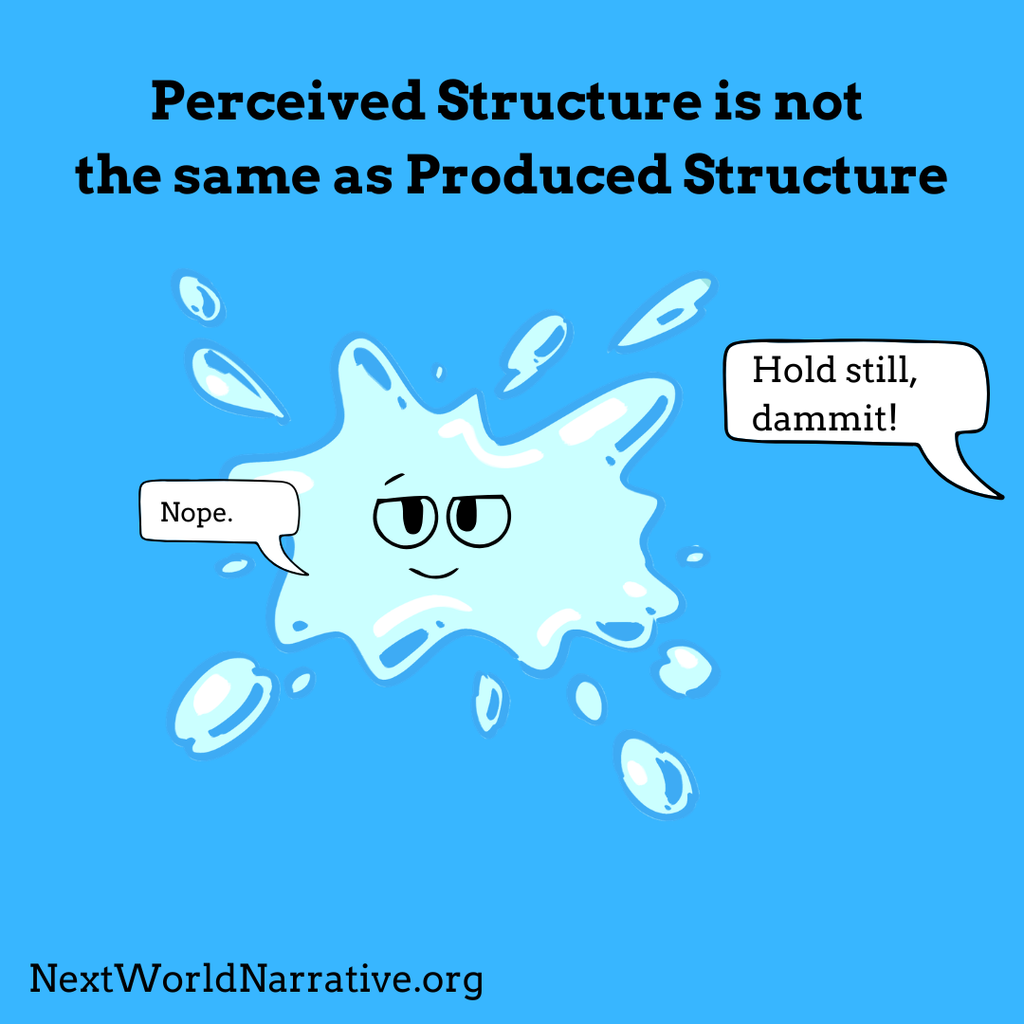
But a final script and released film, TV show, game, or novel is not the same as knowing how it is made.
To be clear, I’m not trying to gatekeep here. It’s important to me that people who are deliberately marginalised out of “industry” are heard. So, to me, credits are not a requirement for being listened to. People speak from different positions. I’m talking about how the process of making as been skewed to fit decisions people come to based on the result of making.
Screenwriter (films) John August talks about this in the podcast, Don’t Be Alone with Jay Kogen. John says that (manuals like those written by McKee and Field) ‘in general, they’re not written by people who actually did the job. They’re written by people who like observed a bunch of movies.’ In reference to their co-written book, Scriptnotes, screenwriter (films, TV) Craig Mazin adds that ‘we we try as best we can to talk about what we do, which is to start with nothing. And get to something. And the people that don’t write for a living and then write books about screenwriting just dissect things that already exist. That’s doesn’t help you when you have nothing.’
Think about the Hero’s Journey, specifically Joseph Campbell’s monomyth. The folktales from different countries, cultures, and centuries (that Joseph Campbell analysed) were not conceived using his chapter-by-chapter run-down on the stages of a hero, or Vogler’s handy infographic. I have no idea how they were developed because neither Campbell or Vogler talk about the creative processes that resulted in the journey they perceive. Now, if you believe Campell’s interpretation, and think that it’s a model that is within us all, or available to us through higher means, then why not talk about how we access that? Isn’t the point to find our own connection, not just copy? Julia Cameron made it about connection. She shifted attention away from the journey depicted on the page or screen to the Artist’s Way.
I’m talking about this because the overrepresentation of end-product voices has skewed people’s understanding of the creative process. Narrative designers try to shoehorn (is that term too old now? Is it illegal in games?) their emerging project into the end design. They feel shame and self-loathing for not being able to fit the prized mold. I know I did. Testers and assessors also get disappointed with the contrast between your work-in-progress and a familiar end product. Testers often think that the end-product is the only signal of skill. Creatives end up learning skills that lead them away from their flourishing. They end up inverting insights.
“Structure is the Symptom”
At the keynote I gave at the Joint Screenwriting Research Network and Sightlines Festival last year (2025), I mentioned the difference between how people think I’ve designed my games and how I actually have. For instance, I had a colleague respond to my Elder Spider character, saying that I was using a “mentor” character, and another colleague citing an “impact” character (ala Dramatica). Since I am versed in both, it is possible they were a subconscious influence. The process of creating was very different, though.
I didn’t start with an archetype. Instead, I started with what I wanted the players to experience: what it’s like to have someone support you because I haven’t had enough of that and it’s amazing when it happens. I also had a lovely brain trust advisor who had shared stories of elder activists. I wanted to value age in part because I’m getting older, I miss my mum who has passed, and I think we need all generations involved in taking action. I ended up doing what many pre-built structures would approve of. But I didn’t start with that or try to do that. Those archetypes don’t capture the wonderful mix of experiences and ideas specific to my journey. Those archetypes didn’t guide me to design the way I did.
Author and critic Samuel R. Delany talks about this disconnect, too. In his essay, ‘Thickening the Plot,’ in Pocket Workshop, Samuel says that discussions of plot often refer ‘to an effect a story produces in the reading’ (original emphasis). But, he says, ‘discussion of effects is only of limited use in a discussion of causes.’ To explain the difference, he talks through the process of writing. Samuel explains ‘that the writing down of words about my imagined vision (or at least the choosing/arranging of words to write down) causes the vision itself to change’ (original emphasis). That’s right. Our idea of the story, game, film, TV show, novel, changes as we create.
He says, the act of writing helps the idea become ‘clearer.’ (In my previous article we spoke about the different functions of externalising.) He adds that ‘the notating process tends to propel that action forward (or sometimes backward) in time.’ Samuel gives an example of how this works. He starts with a vague character George entering a vague room to find a vague Janice. That is his beginning point.
His writing and internal process proceeds: ‘Picture George outside the door. Look at his face; no, look closer. He seems worried…? Concerned…? No. Look even closer and write down just what you see: The lines across his forehead deepened. Which immediately starts him moving. What does he do? … He reached for the …doorknob? No. Be more specific…brass doorknob. It turned…easily? No, the word “brass”…’ [And so on.]
Over two pages, Samuel shares his internal writing process from that vague beginning point. The end result is a couple of paragraphs: ‘The lines across his forehead deepened. He reached for the brass doorknob.[…] Janice sat on the bare mattress […]‘ [And so on.]
Samuel then explains that if a reader is asked to explain the ‘plot,’ they might say, “Well this man comes looking for this woman named Janice in her room; he finds the door open and goes in only she doesn’t talk at first.” Samuel explains that while it is ‘a fair description of the reading experience,’ it’s not ‘what we started with, to write.’ He says what we do is the ‘story process’ and what they describe is ‘plot.’
Game director David Gallaher makes a similar point. He says, “A story does not begin as a clean diagram. It begins as a mess. It begins as fragments, instincts, images, lines of dialogue, half-formed characters, and ideas that contradict each other. It feels less like architecture and more like dumping every toy out of the toy box onto the floor and trying to figure out what belongs together. There is energy in that mess. There is possibility. There is play. [NP] That part is where the story is alive.” (original emphasis)
In a Scriptnotes podcast episode, Craig Mazin also explains the difference between structure perceived by the audience and the one we write. ‘Yes,’ Craig says, ‘screenplay is structure, but structure isn’t what you think it is.’ He says, ‘If you follow strict structural guidelines in all likelihood you will write a very well structured bad script.’ Like Delany’s distinction between cause and effect, Craig says, ‘Structure isn’t the dog. It’s the tail. Structure is a symptom.’ Structure is the result of the work you’ve done, not the cause.
This shift in thinking has implications. It means you can begin with any structure in the world that exists, any structures you mix together, any you generate, and even with no structure at all. Why? Because a structure will happen anyway. Because whatever you do, it will change. It needs to change, and the process needs you.
Unsatisfying Wins
I’ve been down the path of sticking to perceived structures. Just about every narrative designer has. They’re at-hand and (falsely) promise a connection with the masses. I thought, if I secretly mix in myself with their stuff, then I could get away with it. I could pass in the world of straight structure. I did. I’ve won awards for this work. Australian Writers’ Guild and WA Premier’s Book Prize awards for my interactive writing. But it didn’t resonate with audiences as much as it could, or feel as glorious as development does for me now.
Author and educator Felicia Roze Chavez talks about this in her book, The Anti-Racist Writing Workshop. Felicia says, ‘To be fair, I’ve seen the imitation exercise (imitate the “masters”) work again and again, regardless of age or ability.’ She talks about ‘sitting paralyzed before the page thinking, “This poem is neat and I am messy.”‘ She did it, though. She fit her work into the model. ‘But the win,’ she continues, ‘is empty.’ She was ‘never proud of this writing.’ ‘Where is joy? Where is play? Where is accident? Where is failure? Where is risk and discovery?,’ she asks.
My hypothesis is that it isn’t the nature of orthodox structures we use that are the defining factor. It’s that, among other things, their implied use prematurely close down the creation process. Aligning with an existing structure, or mechanics, or whatever it is, gives us the impression that it is complete. All we need to do is fasten those studs, click, click, click, and it will work. When they’re aligned it will appear finished. But the world only we can create hasn’t had a chance to unfurl. It was years later that I would get to know what it feels like for all the elements of all the ingredients I gathered showed their petals.
The Different Skills of Perceived and Produced Structural Design
I call the two different approaches perceived and produced design. [Edit: Argh, ‘produced’ may be a poor word choice considering the prevalence of producers using perceived design. Tell me your thoughts!] Both can be used. But given the prevalence of perceived structure, we need to give voice to the latter. We need to stop conflating them. Stop upholding the idea the outsider is the only position and the only insight of value. We need to also know the value of subjectivity, context, first-hand, and lived experience. We need to stop pretending that perceived design is the same as produced design. Equality is oppressive when differences are denied. Equality is liberating when all belong.
| Perceived Structural Design | Produced Structural Design |
| Projected The reader’s experience of a structure defines what it is. Example Skill: Identify character archetypes Example Skill: Identify existing “master” structures Example Skill: Identify sequence lengths | Subjective Structure is the result of hundreds of micro decisions informed by the creatives’ experiences, associations, views, and needs. Example Skill: Generate ideas by drawing on your pain and what you love Example Skill: Troubleshoot repair of an unforeseen design issue |
| Prescribed Structure is determined by others. Example Skill: Understand and apply existing structure(s) Example Skill: Design pacing of structural stages according to common sequence lengths | Chosen You can select your structure from a wide range of dramatic and real life options, or not use one at all. Example Skill: Map genre and structure Example Skill: Map meaning and structure |
| Pre-Made You don’t make a structure, you use an existing stencil. Example Skill: Apply existing structure | Customised or Generated Structure is malleable and can be designed Example Skill: Adapt existing structures according to your values and experiences Example Skill: Generate a structure based on your body’s rhythms and quirks |
| Persistent The end structure is the same as the beginning structure. It stays the same throughout the entire development process. Example Skill: Fit your ideas to an existing structure Example Skill: Continually audit and conform your work to the structure | Polymorphic Structure changes during development. Example Skill: Experiment with a starter structure Example Skill: Develop methods in mixing structures Example Skill: Design according to local (character, scene, player) needs and notice what emerges |
| All-Purpose Everyone uses the same structure because differences between people and projects are negligible. Example Skill: Removal of all personal elements that conflict with orthodox design | Protean Structures differ according to the people making and experiencing the work. Example Skill: Make any existing structure recognisably your own |
During the Q&A at the screenwriting conference last year, I laughed when I mentioned a benefit of perceived structure. Sometimes people project a traditional structure onto our wild work. Those who try to uphold design orthodoxy can inadvertedly approve of our liberated designs. Heh. Some can’t imagine a world beyond and project theirs everywhere. We’ll make our worlds anyway. We don’t need them to know it exists for us to make it. A liberated designer knows their worlds are real, too.
How to cite this page:
Dena, Christy (2026) “The Difference Between Perceived and Produced Structure” Next World Narrative, 17 September. Last updated 21 September, 2026. https://www.nextworldnarrative.org/articles/produced-design-is-a-bud-unfurled/