I love creating. I love it when people experience what I create. I love what they create. When folks around us have forgotten their love of creation, it’s important we do it anyway.
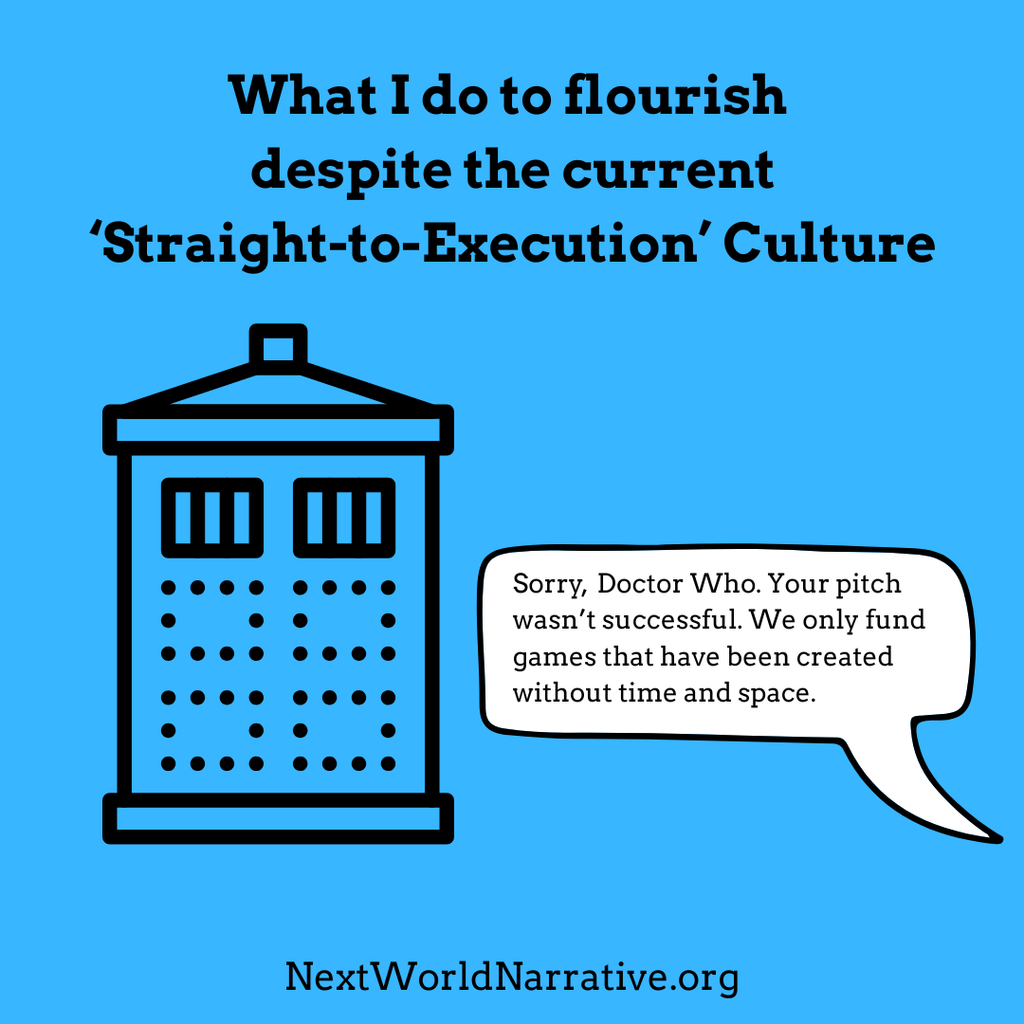
If you’re involved in pitching games, films, TV shows or even books, to publishers, studios, investors, broadcasters, funding bodies, then you’ll know how shitty it is right now. It’s been shitty for as long as design orthodoxy kicked in, but it’s pretty bad at the moment. The shitty topic for today is the straight-to-execution culture we find ourselves in. It’s when publishers and studios expect a script or book to be completely figured out so your pitch doesn’t change throughout production. It’s when publishers expect us to have a (digital) game fully produced, with polished visuals and interactions, and an inbuilt audience as well, before they’ll even consider partnering. Which makes their role kinda redundant and offloads the creative journey entirely. What this expectation results in is a) preference for folks who have no problem publishing first thoughts; and b) a lot of folks going straight to the final look. They invest all their time and resources on art, technical FX, big name casting, and building impressions, likes, and wishlists, and not making a game that works and resonants.
It’s Everywhere
Jane Korneyko of Sova explains the situation in the (tech) startup space: “This is the reality Australian founders are walking into. Not a market that rewards potential, but one that demands demonstrated operational maturity from day one. Investors are no longer funding stories. They are funding execution.”
Similarly, in film and TV, there is an expectation to stay with what you pitch. No development of ideas. You need to have already figured it all out and not change it. TV writer-producer David E Kelley (LA Law, The Practice, Anatomy of a Scandal, Lincoln Lawyer, Goliath, Ally McBeal, etc) and Craig Mazin (Chernobyl, The Last of Us, Sheep Detective, etc) spoke about this:
“With The Practice, with Ally McBeal, with Boston Public, there was no script, no outline, and no real formal pitch. With Boston Public, I sat down with Sandy Grushow, who was running Fox at the time, and said, this is going to be a high school show. It’s going to be a public high school, but it’s going to be about the faculty. It’s going to explore the lives of the faculty and the adversities they face in trying to do their jobs every day.
We talked about the tone. It’ll be both dramatic and comedic. We talked about the kids will be instruments to explore these faculty members as well as the parents. There was an understanding that would be the DNA of the show, but we would then find the show in the writing. Today, it’s very different. When you’re going to pitch a show-
Craig: They want it all.
John: -the buyers are looking for such a specificity, and there’s a danger to that because you’re not letting the writers find and feel their way. If they’re living up to the notes or the outline that was a product of that goal of specificity, it can have a very creatively constraining effect.” — Scriptnotes
You’ll have your own examples of how this applies in your area (tell me about them!).
Why is this happening?
Part of the reason for this happening is, as Jason Della Roca explains, investors stopped trusting their instincts.
Before the pandemic, Della Rocca says, a studio could raise money on a strong prototype and a credible team, on how good an early build felt in the hands. What broke that was not a crash but a glut. The surge in players through lockdown pulled in a wave of investment, and when it receded it left an oversupply of games, and of the studios making them, all pitching at once. The people with money were suddenly seeing far more of everything and could still act on only the same few.
[…] Somewhere in that glut the people writing the cheques stopped trusting their own judgement. Too many bets had missed, playtime had softened after the lockdown highs, and in his words they “lost their confidence in their ability to pick winners.” A funder who no longer trusts it has an obvious way out, which is to let the market do the judging. […] So the burden of proof moved onto the developer. Studios began doing the work a publisher was once meant to do, announcing early, cutting trailers, gathering wishlists, working festivals, viral TikTok posts and Discord, building the evidence of demand before approaching the people with money. Della Rocca calls it “inception publishing,” the point at which a developer has to run the marketing to prove the game is worth marketing. — The Side Quest
That’s not all, though. As deliberate designers, we look to multiple contexts not just the first one.
Another reason for this straight-to-execution-culture is that currently most of the people advising creatives, and those in decision-making positions, are not creatives themselves. We have assessors, managers, producers, and even lawyers telling creatives how to design. I want everyone to have a voice. What I don’t want is those who don’t make with the power to dictate how we make. Indeed, no one should have power over how we make. We have the best knowledge of what we need. Advice is great, but every person ultimately needs to direct their creative process. Those who are more familiar with the result of a creative process don’t know how that output came to be. (I have an article coming about this.) Therefore, they want you to get to something they recognise (an end-product) rather than something they don’t recognise (a work-in-progress).
Part of the reason, too, is the language used to talk about craft. I went over these issues in the workshops I ran recently (and will share in a forthcoming book). There is a deep narrative that ‘thingifies‘ life and creativity. The cumulative effect of all those folks saying that design is a “rule,” “commandment,” a “natural law,” “it was already figured out yonks ago,” and “every single story does the same thing,” — renders design outside our hands. Design isn’t something you figure out, you make, it’s something you “discover.” That means all you have to do is read that book, listen to that guru, copy that “master” and apply it. Bing, bang, done. Design is a thing, not a process or a relationship. This is why many decision-makers and creatives don’t know how to assess quality. They don’t know how to assess process and effect.
Part of the reason, too, is that there are plenty of folks who aren’t in games, film or TV for the joy of making. The majority of game companies in Australia have become service studios (bought up by Keywords). They don’t do original productions, only provide art, programming, design, etc for companies. There can be a beauty in that, but I see so many uninspired by the experience. I also speak with disenfranchised colleagues who work on big name projects. They talk about meetings where it’s all about making the products gorgeous-looking and juicy, and none of the leads give a shit about design. They get paid, praised, and even awards, anyway. So, why bother?
They’ve been taught through a million paper cuts that there is only one criteria: money. It’s a red herring, though. Are developers in big money studios always the best at what they do? No. Are projects that sell a lot always good design? No. Do projects with good design always sell? No. Are projects that sell always good for the world? No.
We can say the problem is “Capitalism.” That is one term. Another I like to use is what political philosopher Sheldon Wolin calls “inverted totalitarianism.” It’s capitalist, yes. It’s anti-working-class, yes. It’s individualist, yes. It’s also not top-down. It’s upstream. What I, and Wolin, means is that it isn’t overtly forced but it is a way of thinking taken on and upheld. Wolin explains that “inverted totalitarianism comes into being, not by design, but by inattention to the consequences of actions or especially of inactions. Or, more precisely, inattention to their cumulative consequences.” Design is just a thing we do to make money for ourselves, that’s it. It’s not a process we need to spend time on. In fact, we can outsource it. We can offload it. Bada bing, bada boom. (The use of GenAI to replace creative process is not a coincidence in this culture — more about this in another post.)
But design does have consequences. For instance, if we put effort into providing more basic universal services, then people who don’t give a shit about creative works wouldn’t bother with creative works. If their basic needs were taken care of, we’d see a lot of people who aren’t here for this kind of creativity, leave. That would be great. I hope they find what enlivens them.
This non-creative-driven, design-is-a-thing, inability-to-assess-quality, and disenchantment is not a great design culture. It corrupts the creative process.
It Corrupts the Creative Process
If we go straight to producing beautiful visuals, polished interactions, the pretty conceals the problems we haven’t solved.
“Because high-fidelity visuals don’t actually create clarity. Rather, they hide the fact that the work wasn’t done, with detail that is every bit as fake as the sketch — but enough to satisfy stakeholders who are looking for an output.” — Pavel Simonson
Pre-defining the end result makes it less likely we’ll achieve it. The creative process involves lots of dead ends and experiments that are unlikely to work. It even means going in the opposite direction at times. See research into the myth of the objective. Professionals behave very differently than those unfamiliar with the creative process would expect.
Professional skill doesn’t mean going straight to the single end product. Nope. It means going straight to multiple possible products.
“The first time most people work with a pro designer, it’s a surprise how much time they spend exploring different possible ideas. It’s not uncommon for a designer who’s working on a watch, or a mobile app, or a toaster oven, to make dozens of sketches and prototypes, maybe even hundreds as they refine the details of how everything looks and works. Many people think, “well, if you’re good at design, you should just be able to design me something good the first time.” But to design something even as seemingly simple as a backpack, designers may spend hours exploring options and asking questions.”
“Not only is picking the first option you come up with not how good design works, it’s not how good decision-making works, either. Would you marry the first cute person you met? Or move to the first country you see in a movie? An analogy offered to me by designer Delaney Cunningham is to think about the last time you bought a new pair of shoes to match a specific outfit. Did you just walk into the store and grab the first pair you saw, without looking at the size, then buy them without even trying them on? Most people know that in order to find the right pair, they have to try many different designs, make observations and then refine their idea of what good is as they go. We also know that there is a tradeoff with shoes between the price, the style and the level of comfort they offer, and every pair is somewhere different in the combination of those three qualities. Buying shoes has a sequence of steps (ha ha) that you must go through to arrive at a good solution. Design works in much the same way. It’s a process for finding and evaluating ideas to get good results.” — Scott Berkun, How Design Makes the World
We miss getting past first thoughts, which are rarely the best. In their paper (how we as creatives put what we have in our head into the world), Alan Dix and Layda Gongora talk about the various functions of “externalising.” We can externalise to pass on already formed ideas (informational). This character says this and then this character says that. Done. This is what many non-creatives think execution is about. Just make it! But there is also how the process of getting it out of our head helps us understand it (formational). Ah, I think I need a transition between this scene and the last. The need to form it helps form the idea. Then there is using the materials to think about the creation (transformational). I can only use three colours here. Hmm, what colour represents that character? Then there is when the materials become the subject of our thoughts (transcendental). Oh, when players see that character they interpret it in a different way, and that means they do this. Do I want my story to be about that? When we can’t iterate as much as we need to, then we end up just publishing our first thoughts.
We end up putting all our energy into design-for-appeal and not design-for-resonance. This is why there are marketing pushes for first weekend and first week sales. Because once they play or watch it, it won’t reach any further. We can possibly get folks in the door, but then they leave pretty quickly, don’t come back, don’t recommend it to others, and so on.
I could go on. Share stuff you see, too. Either way, we’re in a culture where so many of the folks in decision-making positions what us to go straight to the end product without development.
What to do?
For me, I love creating innovative entertainment projects with an eye for positive social impact. I don’t try to be innovative. I just create in a way that makes sense to me. Which happens to be different. I don’t try to change people, either. I do know design is contextual, though, and I want to bring out folks’ best selves. This kind of design takes longer than, “I’ll use existing mechanics and common anti-social themes.” So, here are some of the ways I amplify insights without a proper development budget. Here are ways I do what I love and get to the end they want despite their best efforts.
- Cave & commons
- I get the most out of ideation by leaning into our different ways of seeing the world. We ideate separately and then blend together. It’s the quickest way to get a wide range of really interesting ideas you can then have fun trying to merge. It stops the same people’s ideas dominating, and ensures everyone doesn’t go with the first thoughts shared.
- Regular playtesting
- Putting my work in front of people at all draft stages accelerates my insights. I draw on our shared cognitive worlds to create a new one. I’m testing all the time with my pitches to colleagues while chatting, as well as organised tests. For me, I find it super helpful to understand how players are experiencing the work, and they come up with unintended play I often want to include.
- Deliberate questions
- Design orthodoxy encourages a fix-it culture with no regard for different creations. Feedback often assumes there is something wrong if it’s not finished yet and any difference is to be stamped out. I’ve learnt to be really strategic with my questioning to get past biases and bring back the joy of creating together. (More about this soon, too.)
- Low-fi prototyping
- Digital design is expensive. I’m working on tabletop games as well as digital games and the contrast is astounding. In the tablestop scene, you can pitch a game without art. Why? The publishers know that the game needs to work and art is something they know how to do. I wish digital publishing worked this way. If our games were assessed on the experience they facilitated with players rather than the polish, we’d see so much more wonderful stuff released. Anyway. With this insight, I use low-fi prototypes with my digital games to front-load insights as much as possible. With the 3D multiplayer game I’m currently developing, I’ve used a slide-show prototype, a live RPG, a 2D digital version using stock images, and a boardgame version to test the whole system cheaply. I can actually change something that I don’t like and the design gets better! (I also will release both the digital and tabletop versions.)
- Polymorphic development
- Related to this, I deliberately create the same project in different artforms and platforms. This reveals gaps and provides new perspectives so quickly. For instance, for a previous card game, I created a chatbot version (pre-GenAI), Twine version, and live performance versions. These were all forms I could easily do myself. So, whatever artform you can easily do. Painting? Use that.
- Full-team exposure
- Get the whole team exposed to the playtests. I learnt this from Jarod Spool. It gets everyone on the same page quickly. I’ve had so much time wasted because I’ve had to use broken builds because team members don’t think it’s that much of an issue. Getting them to see the pain players go through fixes that in a second.They don’t need to be in the room lol. Just record and give the team time to check them out.
- Backcasting
- Use strategic reflections as you go. For me, a great way to get insights into what you need to address is to trick our brains using a ‘pre-mortem.’ You pretend the project is finished and didn’t work. You come up with reasons it didn’t work, and reasons it did. They’re golden insights.
- Automation
- Save time by automating repeated steps. Seth Coster’s talk on this was a great help to me. There are plenty of tools (including free ones) around to make it easier to get things done. For instance, a colleague, Ryan, put me onto how I get Google Drive being linked to my desktop. So, I don’t need to upload stuff to online folders. That gives me more time for design.
- Hire Relationships Not Skill
- There is a great talk by Mark Cerny where he covers his method to develop games. One of the things he talks about the is the need to have your best people at the beginning of the process if you’re doing something innovative. There are a couple of counterintuitive things I want to mention here. 1) Best can’t mean skill anymore, and 2) Mass layoffs doesn’t mean great talent is available. I don’t know what the scene is like worldwide, but I know in Australia it is pretty hard to find good folks to hire. Especially programmers. One reason is that the games scene is ageist. It pushes folks with experience out in preference for younger devs. People who have worked in games for 5 years call themselves, and are called, veterans. The common knowledge base continually pivots around what creativity and work looks like when you’re early-career. There are also a lot of people who have been laid-off from big studios. But a good portion of those folks only worked on a portion of the projects. Unlike an independent, they haven’t worked on the full pipeline. For instance, they don’t know how to set-up a project or release it. They only know the bit they were allowed to do. Jonathan Blow talks about this. Not having the knowledge and skills is fine. But this is where soft skills comes in. Yesterday, Trent Kusters gave a private talk to us creatives who got into the Play Now games market. One of the things he quickly mentioned was that “there is no room for brilliant jerks in games.” He said he’s learnt that it is better to hire for trust over skill. I think his advice is helpful. There are plenty of folks with skill who will corrupt the creative process. They’re not there for the journey. I would much rather hire someone I can trust than someone who has the skill. Skills can be taught (with consults, etc). And trust can be broken. But a person who will keep working on their skills, including their relationships, they help the creative process happen.
These are just some of the ways I let the winds in. I don’t make my first thoughts. I listen to what I create. I listen to my team. My players. The world. The process. Straight-to-execution culture doesn’t like time. I used to hate time, too. But now I love it. I love the gift it brings. Change. I want a project that changes. I want a project that changes with every person, animal, and bug it touches. The world isn’t done.
How to cite this page:
Dena, Christy (2026) “What I Do To Flourish Despite the Current Straight-to-Execution Culture” Next World Narrative, 9 September. Last updated 10 September, 2026. https://www.nextworldnarrative.org/articles/flourish-despite-straight-to-execution-culture